Hosting

Object Caching With Redis: 7 Essential Checks for a Safe Setup
Page caching can reduce work for public pages, while administrative screens and personalized requests often still need application and database processing. That’s where object caching with Redis helps — it stores the results of database queries in memory so WordPress doesn’t have to ask again.
This guide explains what object caching is, how it differs from page caching, how to check whether your host supports Redis, how to enable it, and how to measure the difference.
Every time WordPress builds a page, it runs database queries for options, posts, users, and settings. Object caching can store reusable application data in memory, reducing repeated work when the relevant code uses the cache. Cache access still has a cost.
WordPress has a built-in object cache, but it only lasts for a single page load. A persistent object cache like Redis or Memcached keeps results between requests, which is where the real gains come from.
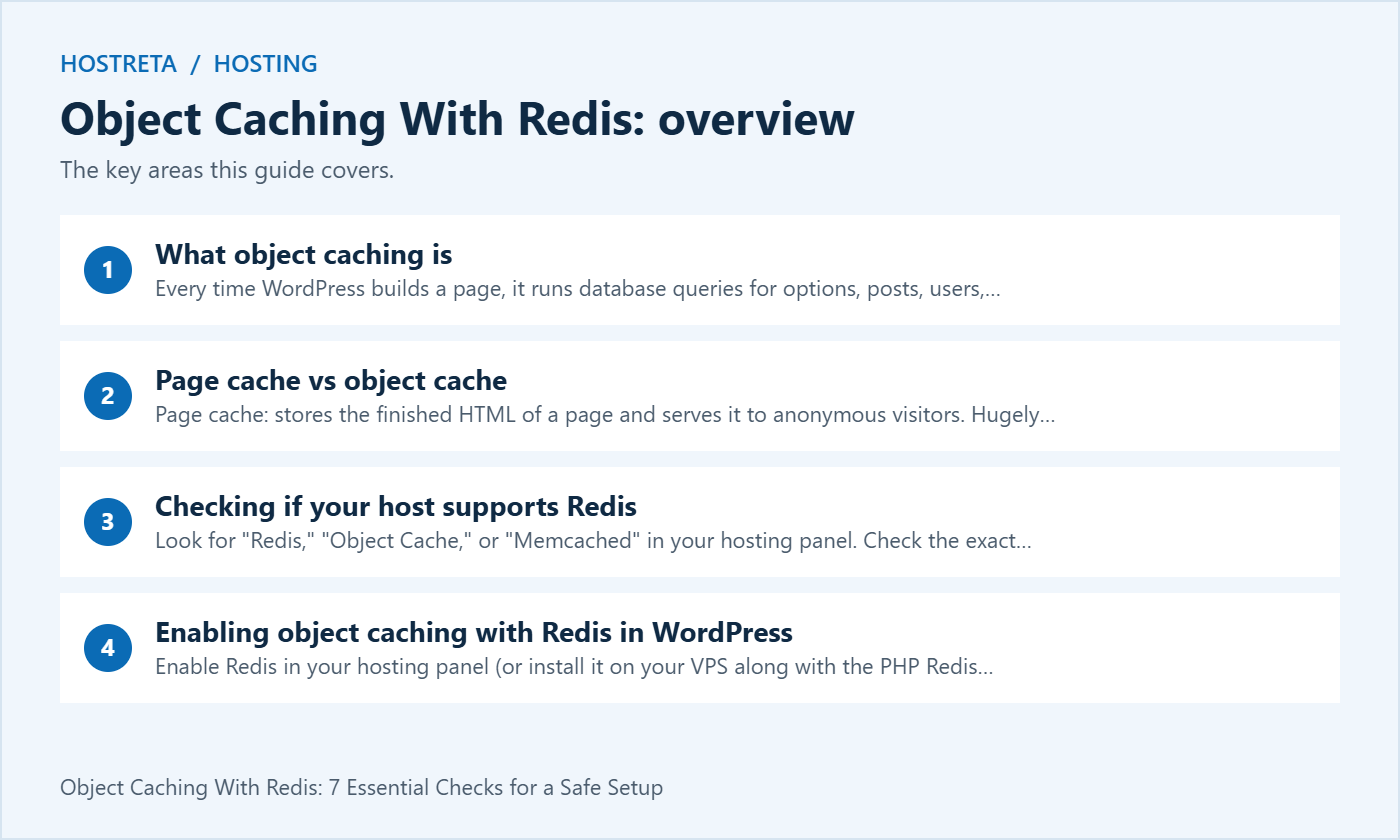
They work together: page caching for visitors, object caching for everything dynamic. Start with page caching if you don’t have it yet — see Best WordPress Caching Plugins Compared.
object-cache.php drop-in file.If something looks wrong, disable the object cache from the plugin and flush it. On shared services, use the host’s supported isolation model. Database numbers or key prefixes can avoid name collisions, but are not a substitute for security boundaries.
Expect the biggest wins on busy sites, stores, membership sites, and heavy admin screens. A small brochure site with good page caching may see little change.
The right plan makes these checks far easier. For WordPress sites, Kawedma WordPress hosting and managed WordPress hosting powered by Rocket.net include caching, staging, and backups. Growing sites that need guaranteed resources can choose a Kawedma VPS server, cloud hosting, a managed VPS from Hosting.com, or an unmanaged VPS if you prefer full control.
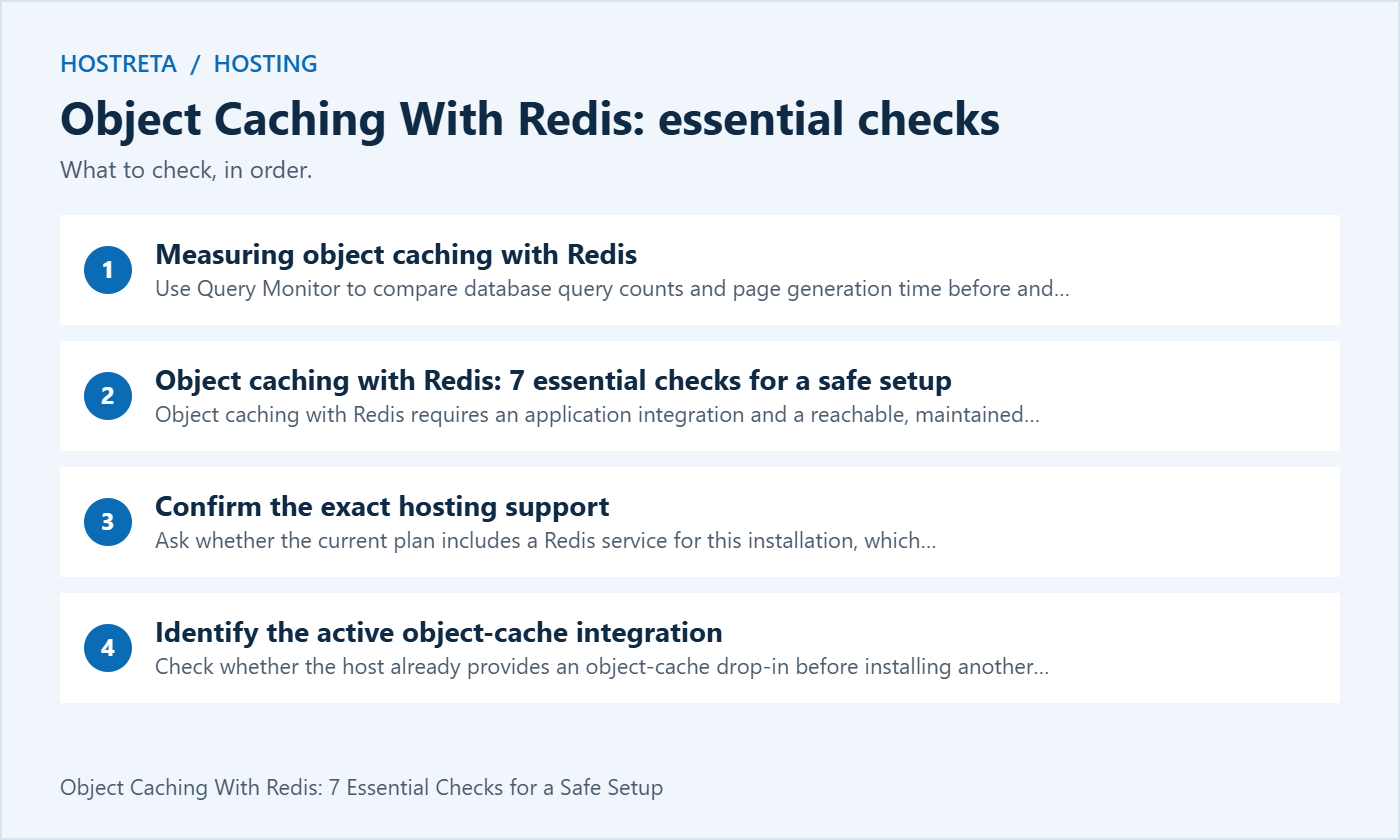
Object caching with Redis requires an application integration and a reachable, maintained Redis service. Installing a WordPress plugin alone does not provide that service. Before enabling anything, establish the host’s supported configuration and how to recover if the service becomes unavailable.
Start with a practical question: which dynamic workflow is currently expensive, and what improvement would matter? A useful evaluation compares representative requests, confirms fresh data after changes, and records operating responsibilities. It does not assume that every site needs another infrastructure component simply because Redis is available.
Ask whether the current plan includes a Redis service for this installation, which integration the host supports, and who maintains it. Object caching with Redis may be managed by the host or installed by your own administrator. Those arrangements have different responsibilities for updates, access restrictions, memory limits, and incident response.
Request the supported connection details through a private channel: endpoint or socket, authentication method, transport requirements, and client compatibility. Do not infer them from an unrelated tutorial. Ask about usage limits and whether the service is dedicated or shared so you can plan an appropriate isolation and monitoring model.
Check whether the host already provides an object-cache drop-in before installing another manager. WordPress uses a special integration file for this role, and competing products can overwrite or conflict with it. Object caching with Redis should have one clear owner and a documented method for enabling and disabling the supported integration.
The WordPress object cache reference explains that persistent caching needs a backend integration; a configuration flag alone does not supply it. Use the Redis Object Cache plugin documentation or the host’s own instructions for the chosen implementation rather than combining settings from several products.
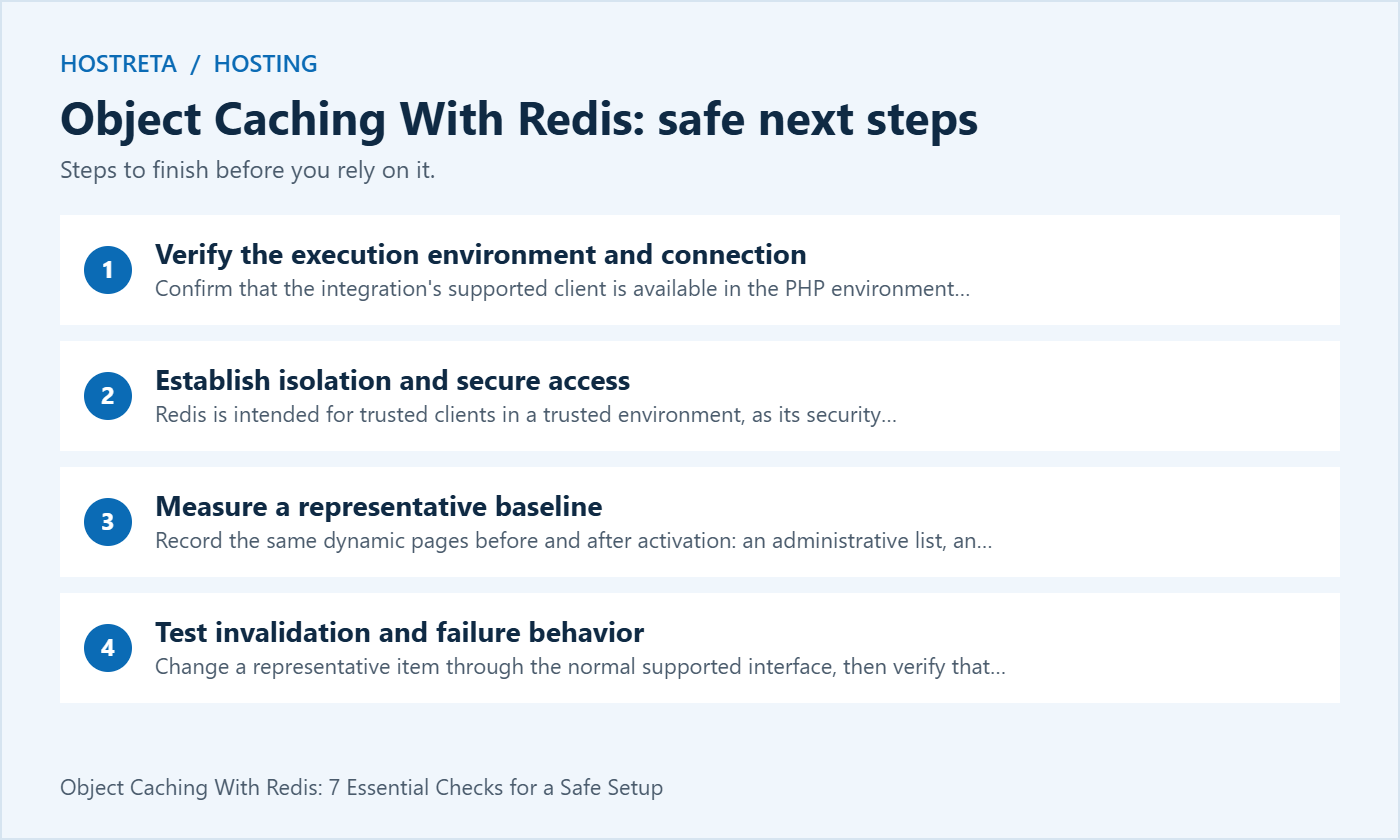
Confirm that the integration’s supported client is available in the PHP environment serving the website. A command-line check can use a different PHP installation from web requests. Object caching with Redis needs the actual application process to connect successfully with the right permissions, credentials, and transport configuration.
Use the integration’s diagnostics and a controlled staging request to verify operation. A service shown as running in a hosting panel is only one part of the chain. Record the connection result, effective target, and any error message without including secrets in screenshots or public support threads.
Redis is intended for trusted clients in a trusted environment, as its security documentation explains. Do not expose a Redis endpoint publicly as a shortcut to making WordPress connect. Have the responsible operator configure network access, authentication, and any required encryption.
Separate production, staging, and unrelated sites using the provider’s supported model. Object caching with Redis must not let a test environment read or overwrite production cache keys. Prefixes help namespace keys, but namespace separation alone does not establish a complete access-control boundary between mutually untrusted clients.
Record the same dynamic pages before and after activation: an administrative list, an authenticated account screen, or another relevant request. Object caching with Redis is most meaningful when the tested code reuses cacheable data. A public page served entirely from a page cache may not exercise the application path you are trying to optimize.
Keep versions, data, user role, and cache conditions consistent. Separate warm-cache observations from the first request after a flush. Record a range of samples rather than a single best number, and include application correctness. A faster response is not useful if it displays stale or unauthorized information.
Change a representative item through the normal supported interface, then verify that affected screens show the new value. Object caching with Redis needs correct invalidation as well as fast reads. Test important dependencies such as an updated setting, edited article, or product change according to the site’s actual workflows.
Ask how the chosen integration behaves if Redis is unavailable. Test that scenario only in a controlled environment with an agreed recovery plan. Do not assume every product falls back identically. Record how to disable the integration safely and how the site returns to its ordinary database-backed behavior.
Decide who watches connection failures, service memory, evictions, and user-visible errors. Object caching with Redis adds a dependency that needs an owner even if the plugin dashboard normally looks healthy. Include the setup in hosting migration and PHP upgrade documentation so it is revalidated after environment changes.
Review outcomes after ordinary maintenance and after material growth in data or traffic. Capacity that was adequate at launch may need adjustment later. Keep operational notes about the integration, isolation, recovery, and verification steps so a future administrator can maintain the arrangement without reconstructing it from memory.
| Question | Why it matters |
|---|---|
| Is Redis supported on this exact plan? | Availability is a plan and configuration detail |
| Which WordPress integration should we use? | Avoids competing drop-ins and unsupported settings |
| How are production and staging isolated? | Prevents collisions and inappropriate access |
| What memory and connection limits apply? | Defines operating capacity and expected constraints |
| How are failures reported and handled? | Establishes monitoring, ownership, and recovery |
| What must be rechecked after migration? | Protects against stale paths and connection details |
Keep the answers with the site’s operating notes. Object caching with Redis should be a supported configuration, not a collection of copied constants whose purpose nobody remembers. If a host recommends its managed integration, understand that process before replacing it with a separate plugin.
A cache hit indicates that a requested key was found under the integration’s reporting model. It does not establish that the whole page is fast, that the value is current, or that the database is no longer used. Interpret counts and ratios together with the workload and measured request times.
Object caching with Redis can reduce repeated data retrieval where WordPress and plugins use the relevant cache APIs. It does not automatically cache arbitrary custom SQL or every remote call. A poorly written loop can remain expensive even with many cache hits, especially if it makes a very large number of cache requests.
Compare outcomes rather than targeting a fashionable ratio. Record whether an important screen responds more consistently, whether database work falls, and whether the host remains within capacity. If the change adds complexity without a useful result, reconsider whether that site currently needs the persistent cache.
A cold cache contains few or none of the values that subsequent requests may reuse. Initial requests can need more database work while the cache warms. Plan measurements accordingly, and avoid repeatedly flushing during a comparison unless the cold-cache behavior is the specific question being tested.
Do not flush a shared Redis service indiscriminately. Establish whether a control affects one site’s keys, a logical database, or a wider service. Object caching with Redis should use the supported scoped operation for the intended site. A broad flush can create load or disrupt unrelated applications sharing the instance.
Before disabling or replacing an integration, follow its documented sequence and retain a backup of configuration details. If the site fails, restore the known working arrangement through independent hosting access. Treat the cache as a performance layer with a recovery plan rather than assuming it can never affect availability.
Use synthetic users and supported payment test modes on staging. Check account updates, relevant permissions, product changes, cart behavior, and other personalized workflows. Object caching with Redis must preserve separation between users and reflect changes according to the application’s requirements.
Do not apply public page-caching rules to private pages merely because object caching is active. These are separate layers with different responsibilities. A correctly configured object cache does not make it appropriate to serve one customer’s rendered account page to another customer from a full-page cache.
Keep a small acceptance matrix with the action, expected data, user role, result, and time. Repeat it after enabling the cache and after relevant updates. Check correctness under more than one account so you do not miss a problem that appears only when different users request related data.
Ask the operator what memory limit and eviction policy are configured. Eviction means keys can be removed under the service’s rules, which may lower reuse and increase backend work. Interpret that evidence in context rather than assuming every eviction is an outage or that a larger allocation is always the first answer.
Object caching with Redis uses service memory in addition to PHP and database resources. Check the host’s allocation model and the costs of the proposed setup. Avoid taking memory from a constrained database merely to increase the cache without measuring the overall result.
When the workload grows, investigate key churn, unexpectedly large cached values, repeated misses, and connection behavior with the responsible developer or host. Keep diagnostics sanitized. The right response may be code changes or better cache use rather than a simple plan upgrade.
Consider a fictional membership site where an administrative screen repeatedly retrieves the same configuration and related content. Establish a baseline with the same account and data, then enable the host-supported integration on staging. Object caching with Redis is a plausible candidate because the workload may reuse cacheable application data between requests.
Repeat the screen after warm-up and record generation time, database activity, errors, and the visible result. Next edit a relevant setting and confirm that the new value appears. The performance observation and invalidation test answer different questions; both matter before release.
If the result is inconsistent, compare the code paths and connection evidence. Do not invent a percentage improvement or assume that a plugin’s connected status proves a successful optimization. Report what was measured, under which conditions, and which tasks remain outside the evaluation.
Give the implementer the hosting plan, selected integration, representative workflows, isolation requirements, and acceptance tests. Ask for a documented recovery procedure and the location of relevant diagnostics. Object caching with Redis is easier to maintain when the handover explains the operating model rather than only stating that it was enabled.
KAWEDMA offers hosting and website development services if you need help assessing support or implementation. Confirm the scope and supported configuration with the provider. The required outcome is a tested, maintainable setup with clear ownership, not merely an additional plugin appearing in the dashboard.
A WordPress integration and the Redis service are separate parts of the setup. Confirm that a reachable service exists and is supported by the host. Installing an integration does not automatically provision a properly secured server or establish the correct connection configuration.
No. Object caching with Redis can reuse eligible application data, but requests can still need database reads and writes. Some code does not use the relevant cache mechanisms, and fresh or invalidated data may need retrieval. Evaluate the important workload rather than expecting a zero-query website.
No. Keep an independent backup and restore process for the website and its persistent data. A cache is not a substitute for protected database and file backups. Do not rely on cached values as the only recoverable copy of customer or business records.
Confirm the supported connection, isolation, representative performance result, data freshness, recovery route, and monitoring owner. Object caching with Redis should preserve important user journeys and fit the host’s operating policy. Record the verification date and recheck after meaningful environment changes.
We may earn a commission on purchases made through these links, at no extra cost to you.
Don’t miss the chance to participate in the biggest giveaway of this year.