Dev & Security

PCI Compliance Basics for Small Online Stores
The moment your store accepts card payments, a set of security rules applies to you — even if you’re a one-person business working from a kitchen table. The good news is that for most small stores, PCI compliance comes down to a handful of sensible habits plus letting your payment provider do the heavy lifting. You don’t need a security team; you need the right setup and a little discipline.
This guide is updated for PCI DSS v4.0.1, the current version of the standard, including the January 2025 changes to the simplest self-assessment questionnaire that took effect on March 31, 2025. It explains what PCI DSS is, who needs to comply, how hosted gateways reduce your responsibility, what changed recently, the everyday habits that count, how self-assessment works, and what to do before the holiday rush. It is a general overview, not legal or compliance advice — your payment provider has the final word on your obligations.
PCI DSS (Payment Card Industry Data Security Standard) is a set of security requirements created by the major card networks and maintained by the PCI Security Standards Council. It covers how card data is handled, stored, and transmitted, and exists to reduce fraud and data breaches.
It isn’t a law, but it’s part of your agreement with your payment provider. Serious failures can mean fines, higher fees, or losing the ability to take cards. PCI compliance is also simply good security: the same steps that satisfy the standard protect your customers and your reputation.
Attackers know small stores often have fewer defences than large retailers. Common attacks include injecting skimming scripts into checkout pages (so-called Magecart attacks), card testing with stolen numbers, and taking over admin accounts with reused passwords. Most of these attacks are automated, so being small doesn’t make you invisible. Good PCI compliance habits block the majority of them.
Any business that accepts, processes, stores, or transmits card data — regardless of size. Requirements scale by transaction volume, and the vast majority of small online stores fall into the smallest merchant level, with a short self-assessment rather than a full audit by a qualified assessor.
Your acquirer or payment provider tells you which self-assessment questionnaire (SAQ) applies. Many providers, such as Stripe and PayPal, guide you through this inside your account dashboard, and some complete much of it for you based on how you integrate.
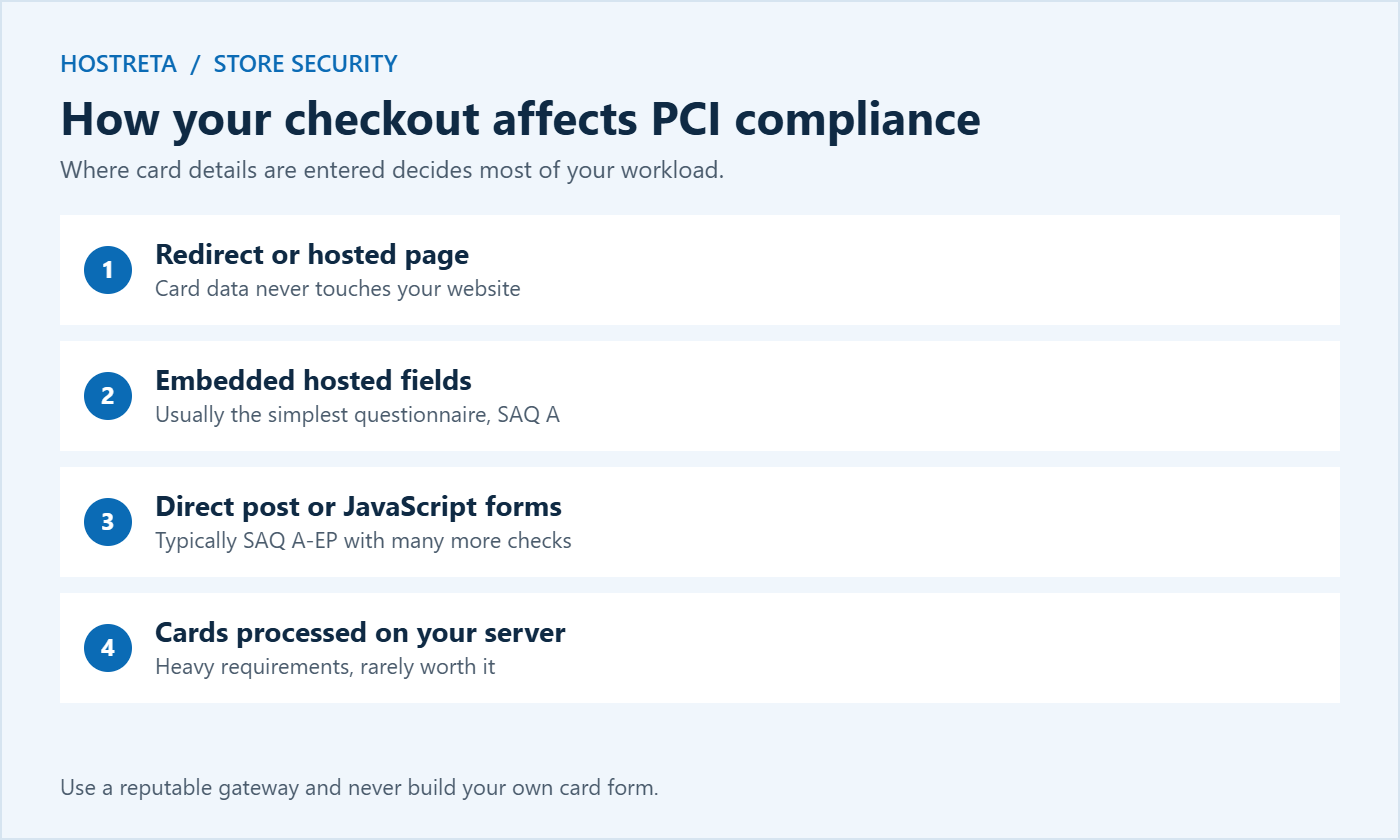
The single biggest factor is where card details are entered:
Practical rule: use a reputable gateway’s hosted fields or hosted page, keep the payment plugin updated, and never build your own card form. Payment options are compared in Payment Gateways Explained: Stripe, PayPal and More.
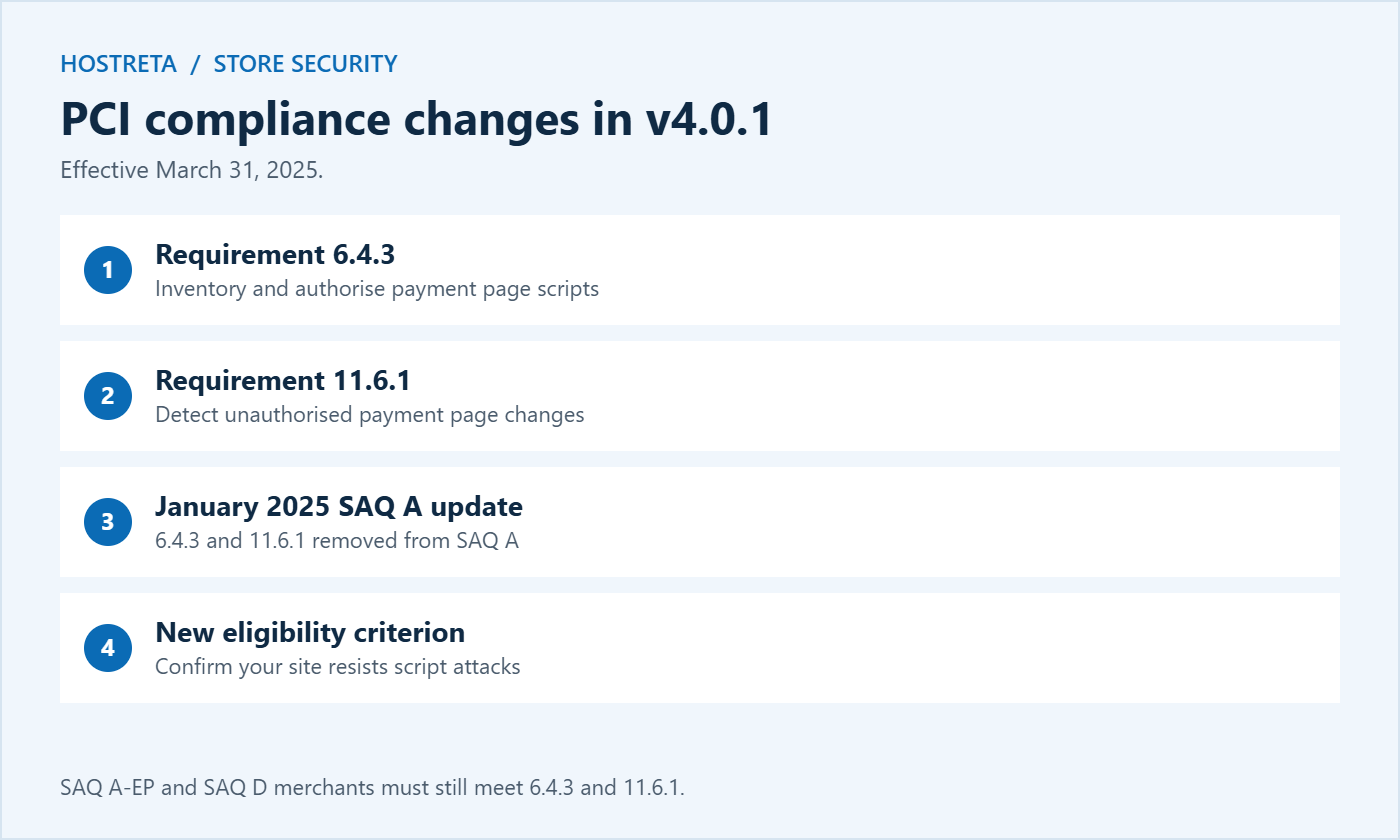
Version 4.0 introduced two requirements aimed at checkout skimming: 6.4.3, which requires an inventory and authorisation of scripts on payment pages, and 11.6.1, which requires detecting unauthorised changes to those pages. They became mandatory on March 31, 2025.
In January 2025, the Council revised SAQ A. Requirements 6.4.3 and 11.6.1 (and the related risk analysis in 12.3.1) were removed from the questionnaire, and a new eligibility criterion was added: merchants must confirm their site is not susceptible to attacks from scripts that could affect their e-commerce systems. In practice, that means you still need to protect your website against malicious scripts — the questionnaire is shorter, but the responsibility remains. Merchants on SAQ A-EP or SAQ D must still meet 6.4.3 and 11.6.1 in full.
If card data never touches your server, your host isn’t processing payments. But your website still has to be secure enough to resist script attacks, which depends heavily on hosting. Look for account isolation, current PHP versions, a firewall, malware scanning, automatic backups, and responsive security support — see Is Your Hosting Secure? 12 Features to Check.
Kawedma WordPress hosting and managed WordPress hosting powered by Rocket.net handle updates and security layers for you. Larger stores that want isolated resources can choose a Kawedma VPS server or a managed VPS from Hosting.com. Keep off-site backups with a service such as CodeGuard so you can recover quickly from any incident.
Even small businesses benefit from a one-page policy: who has admin access, how passwords and two-factor authentication are managed, how often software is updated, how backups are kept, and what to do in an incident. It helps with PCI compliance questions and makes sure nothing is forgotten when you’re busy.
With Black Friday on November 27 and Cyber Monday on November 30, 2026, run these checks before your code freeze:
PCI compliance is built on twelve high-level requirements grouped into six goals. As a small store using hosted payments, many will be handled by your provider, but it helps to know what they cover:
For a store on SAQ A, the questionnaire covers only a small subset of these. Still, treating the twelve as a checklist for your whole website is a practical way to strengthen PCI compliance and general security together.
Stores that offer subscriptions or saved payment methods don’t store card numbers themselves. Instead, the gateway stores the card and gives your store a token. This keeps PCI compliance manageable even for recurring billing, as long as you never capture raw card data in custom forms or plugins.
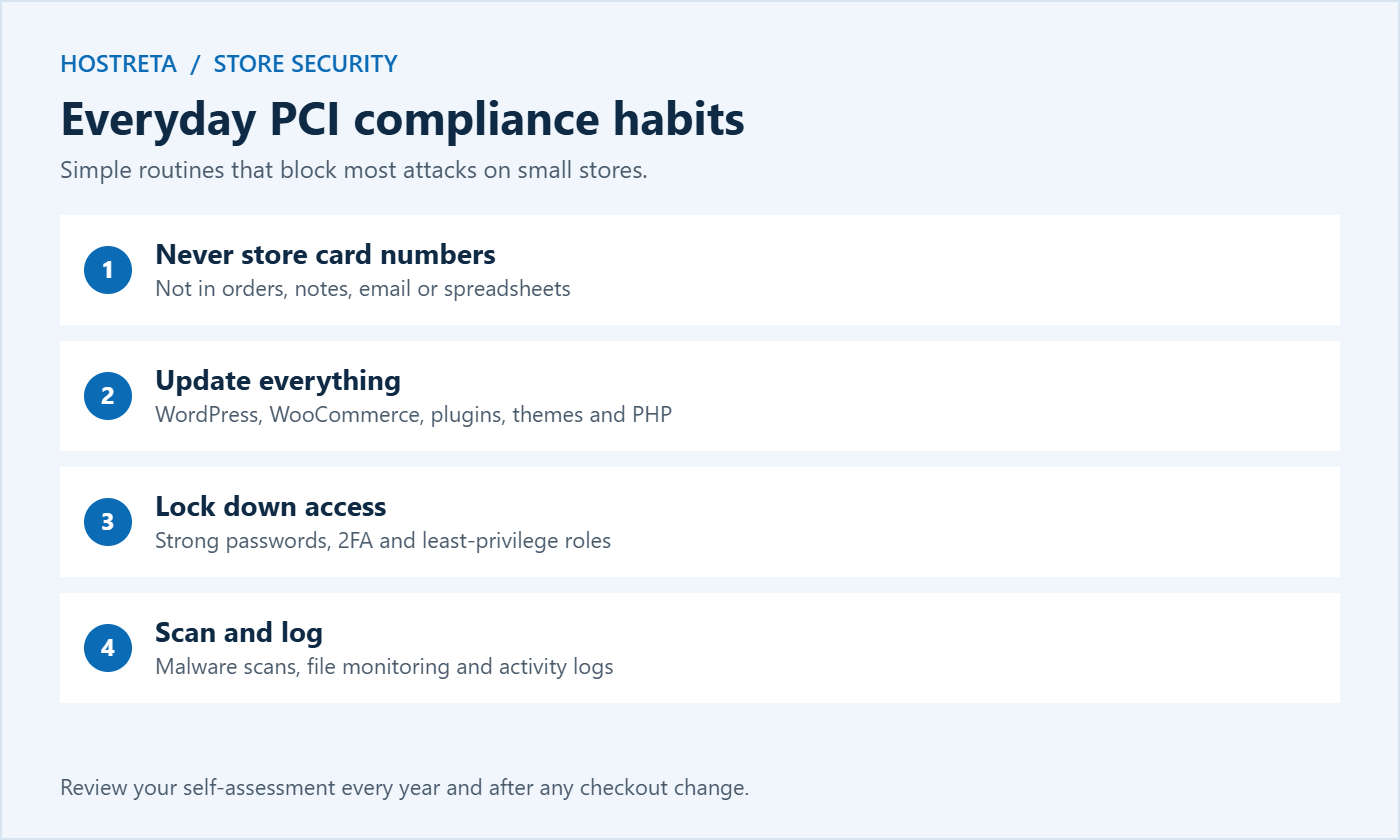
Avoiding these mistakes takes little time and does more for PCI compliance than any expensive tool.
People are often the weakest link. Make sure everyone who works on your store knows the basics: never ask for or record card details, spot phishing emails, use a password manager, and turn on two-factor authentication — see Phishing Emails: How to Spot Them in 5 Seconds and Two-Factor Authentication Apps Compared. Review user accounts every quarter and remove anyone who no longer needs access. These habits strengthen PCI compliance and protect against the most common attacks on small businesses.
Turn PCI compliance into a simple annual routine instead of a stressful one-off project:
Put these dates in your calendar. A few minutes each month keeps PCI compliance current, and it means you’re always ready if your payment provider asks for evidence.
Store a simple folder with your completed questionnaire, scan reports, your security policy, a list of admin users, and notes on how you protect checkout from script attacks. Date every document. If you ever face questions from your provider after an incident, organised records show you took PCI compliance seriously.
Yes, but using their hosted fields or hosted pages greatly reduces your responsibility, usually to the short SAQ A questionnaire plus keeping your website secure.
No. Self-assessments are typically completed annually, and you should review your setup whenever you change your checkout, theme, or payment provider.
Gateways usually provide a masked card reference for your records. Never store full card numbers or security codes yourself.
SSL is required, but it’s only one part. PCI compliance also covers updates, access control, script security, and policies.
Nothing may happen at first, but if a breach occurs, your provider can apply penalties, raise fees, or stop you accepting cards. You may also face costs for investigation, customer notification, and lost trust.
Yes. Any store that accepts card payments needs it, whether it sells physical goods, digital downloads, or services. The same hosted-payment approach keeps the workload small.
Start with your payment provider’s support and documentation. For complex setups or larger volumes, a qualified security assessor or consultant can review your systems.
For most small stores, the path is clear: choose a trusted gateway with hosted fields, keep your website clean and updated, protect admin access, and review your setup once a year. Do that consistently and you will meet your obligations while giving customers a checkout they can trust, during the holiday rush and every other day of the year.
Start today with one step: check which questionnaire your provider says applies to you.
We may earn a commission on purchases made through these links, at no extra cost to you.
Don’t miss the chance to participate in the biggest giveaway of this year.