Dev & Security

How to Back Up a WooCommerce Store Without Losing Orders
Restoring a backup is supposed to save you. On a store, it can also destroy a day’s orders — because the backup you’re restoring was taken before those orders existed. Knowing how to set up a WooCommerce backup properly, and how to restore one safely, is as important as having backups at all.

This guide is updated for 2026 and focuses on the practical side: why a WooCommerce backup is different from a normal site backup, what to include now that orders live in HPOS tables, choosing frequency, real-time versus scheduled backups, tools and storage, safe restore strategies, and how to test before Black Friday on November 27, 2026. For the peak-season plan around code freezes and incident response, see the companion guide Store Backup and Rollback Plan for Peak Sales Days.

Why a WooCommerce backup is different

  • Orders arrive constantly and can’t be recreated.
  • Payments are already taken — a lost order record means a customer who paid and has nothing to show for it.
  • Stock levels change with every sale.
  • Customer accounts and coupon usage update continuously.
  • Subscriptions, bookings, and memberships often store data in their own tables.
  • The database grows fast, so backups get large and slow.

A blog can happily restore yesterday’s copy. A store usually can’t. That’s why a WooCommerce backup strategy starts with the database and treats orders as the most precious data you hold.

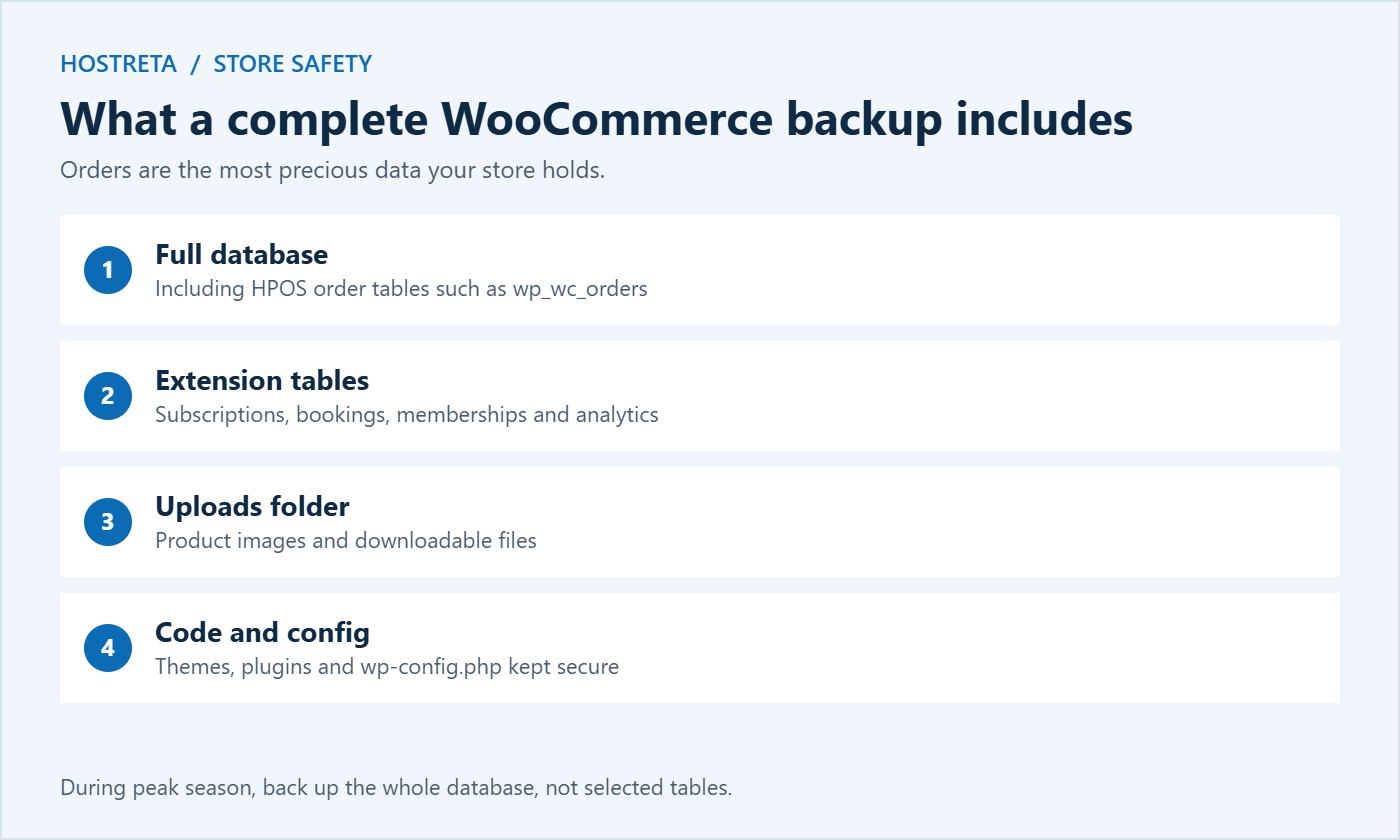
What a complete WooCommerce backup includes

  • The full database, including WooCommerce’s High-Performance Order Storage tables such as wp_wc_orders, which have been the default for new stores since WooCommerce 8.2.
  • Extension tables for subscriptions, bookings, memberships, and analytics.
  • The uploads folder with product images and downloadable files.
  • Themes, plugins, and must-use plugins, including any custom code.
  • Configuration files such as wp-config.php, stored securely because they contain credentials.

Partial backups that only copy posts and postmeta are no longer enough for most stores. During peak season, back up the entire database rather than a hand-picked list of tables. The general principles are covered in the official WordPress backup documentation.
What a complete WooCommerce backup should include

Choosing WooCommerce backup frequency

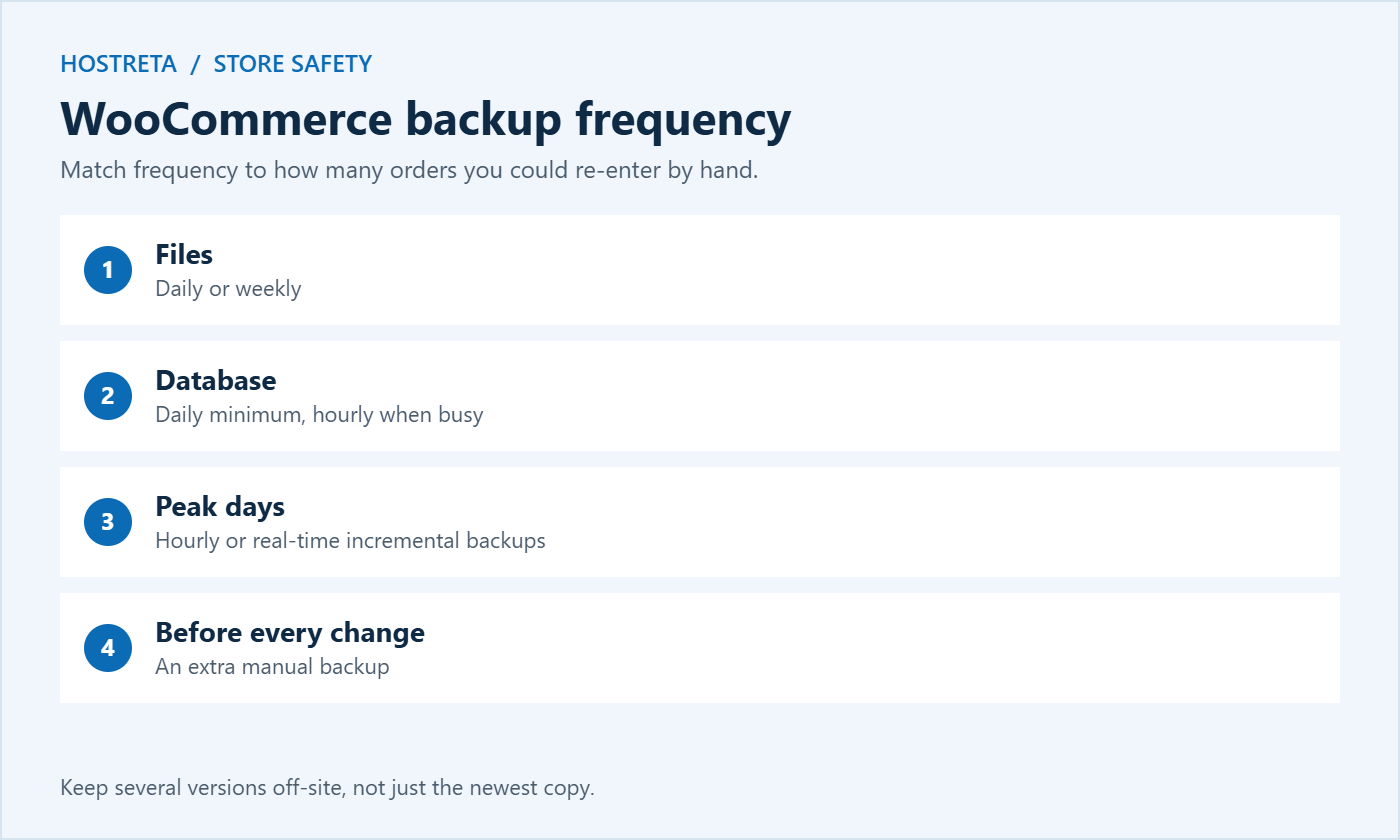
  • Files (themes, plugins, uploads) change rarely — daily or weekly is fine.
  • Database changes constantly — daily at minimum, hourly during busy periods.
  • Peak days: hourly or real-time database backups.
  • Before every change: an extra manual WooCommerce backup.
  • Retention: keep several versions, not just the newest, in case a problem goes unnoticed for a day.
  • Off-server storage is essential — a backup on the same server disappears with the server.

Matching frequency to order volume

Ask yourself how many orders you could afford to re-enter by hand. A store with five orders a day might accept a daily backup plus order exports. A store with fifty orders an hour needs real-time or at least hourly database backups, because even a short gap means dozens of orders to recover. Write down that number — your recovery point objective — and choose tools that meet it.

Real-time vs scheduled WooCommerce backups

Scheduled backups run at fixed times. Simple and cheap, but anything after the last run is at risk.

Real-time (incremental) backups capture changes as they happen, so orders are saved within moments. Services such as Jetpack VaultPress Backup and several managed hosts offer real-time backups for stores, usually as a paid tier. Incremental backups also put less load on the server because they only copy what changed.

For a store taking more than a handful of orders a day, real-time or hourly database backups are worth the cost. Compare tools in Best Backup Plugins for WordPress Compared.

Tools and storage for a WooCommerce backup

  • Host backups: convenient daily snapshots — see How to Set Up Automatic Backups on Your Hosting. Check frequency, retention, and restore options.
  • Backup plugins: UpdraftPlus, BlogVault, Jetpack VaultPress Backup, and similar tools that send copies to cloud storage.
  • External backup services: automated tools such as CodeGuard from Kawedma that back up files and databases daily and keep version history outside WordPress.
  • Cloud storage: Amazon S3, Google Drive, Dropbox, or Backblaze B2 as off-site destinations.
  • Order exports: a daily CSV of recent orders as a human-readable safety net.

Hosting that includes backups and staging simplifies everything. Kawedma WordPress hosting and managed WordPress hosting powered by Rocket.net include automatic backups, while a Kawedma VPS server or managed VPS gives larger stores room for frequent database snapshots.
How often to run a WooCommerce backup

Safe WooCommerce backup restore strategies

Never restore a full database over a live store without thinking. Instead:
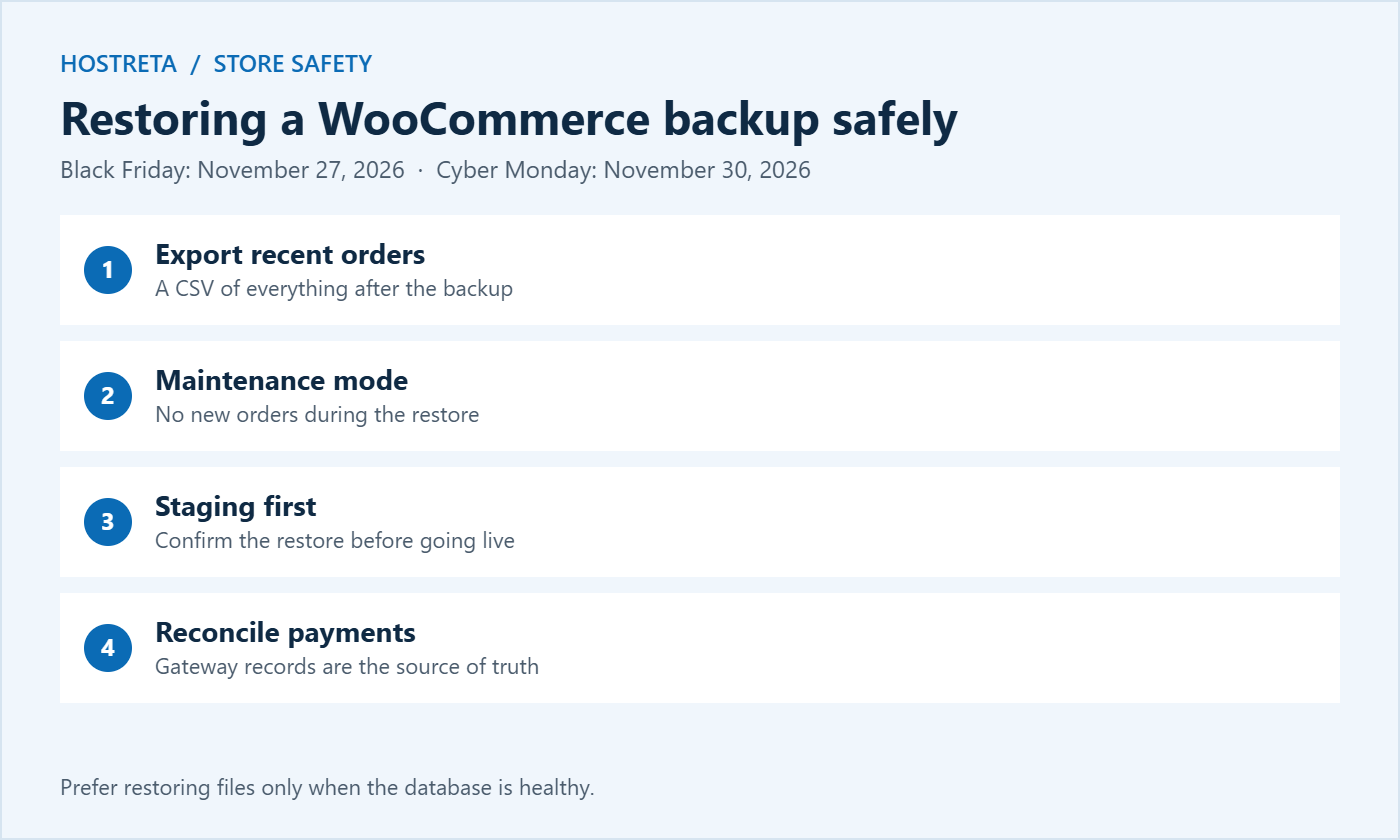
  1. Export recent orders to CSV first, so you have a readable record of anything the backup predates.
  2. Put the store in maintenance mode so no new orders arrive mid-restore.
  3. Restore to staging first where possible, confirm it’s good, then promote it — see Best Staging Tools for WordPress.
  4. Prefer partial restores: if a plugin broke the site, restore the files only and leave the database alone.
  5. Re-enter missing orders manually from your CSV or gateway records if needed.
  6. Reconcile with your payment gateway afterward — it’s the authoritative record of what was actually paid.
  7. Check stock levels for products sold after the backup.

Testing a WooCommerce backup on staging

  • Restore your most recent backup to a staging site and check products, orders, customers, settings, and images.
  • Time the restore so you know your worst-case downtime.
  • Test a database-only restore as well as a full one.
  • Make sure staging can’t send emails or take payments.
  • Write the steps down and keep them accessible from your phone.
  • Repeat the test every few months and before each peak season.

How to restore a WooCommerce backup without losing orders

Step-by-step: setting up a reliable WooCommerce backup

  1. Check what your host already provides: frequency, retention period, storage location, and whether restores are free and self-service.
  2. Choose an independent backup tool — a plugin or an external service — so you always have a copy that doesn’t depend on your host.
  3. Connect off-site storage such as Amazon S3, Backblaze B2, Google Drive, or Dropbox, with its own strong password and two-factor authentication.
  4. Set schedules: daily files, daily database in normal weeks, and hourly or real-time database copies from mid-November until early December.
  5. Set retention: at least 30 daily copies and a few monthly copies.
  6. Turn on failure alerts by email or app notification.
  7. Add a daily order export to CSV, stored somewhere you can reach even if the site is down.
  8. Run your first WooCommerce backup manually and confirm it completed and arrived in storage.
  9. Test a restore on staging before you rely on it.

This setup takes an hour or two and protects you for years. Review it every quarter and before every big promotion.

Encrypting and securing backups

A WooCommerce backup contains customer names, addresses, emails, and order history, so it must be protected like the live store. Encrypt archives where your tool allows it, restrict access to the storage account, and never leave backup files in a public folder on your server where they could be downloaded. Delete old copies on a schedule that matches your privacy policy. These steps also help with data protection rules such as GDPR — see Privacy Policy and Cookie Consent.

Recovering orders after a restore

If you ever have to restore the database, orders placed after the WooCommerce backup will be missing from WordPress. Recovering them is manageable if you prepared:

  • Use your order CSV to see exactly which orders are missing.
  • Check your payment gateway — Stripe, PayPal, and others keep complete transaction records with customer details.
  • Check new-order emails in your inbox as another record.
  • Recreate orders manually in WooCommerce, or use an import tool, marking them clearly.
  • Adjust stock for items sold in the gap.
  • Contact affected customers if anything about their order changed, such as delivery dates.

The shorter the gap between your last backup and the incident, the less of this work you’ll face — which is the strongest argument for real-time or hourly database backups on busy stores.

Common WooCommerce backup mistakes

  • Only backing up files, missing the database where orders live.
  • Selecting tables manually and missing HPOS or extension tables.
  • Storing every copy on the same server as the store.
  • Never testing a restore until disaster strikes.
  • Ignoring failed backup alerts for days or weeks.
  • Restoring the full database when a files-only restore would have fixed the problem.
  • Forgetting to export orders before restoring.

Protecting the store so you rarely need a restore

The best backup is the one you never need. Reduce the chance of a restore with good security and careful change management: keep software updated, use strong passwords and two-factor authentication, scan for malware with a tool such as SiteLock, secure checkout with an SSL certificate, and test updates on staging. Monitor uptime with 360 Monitoring so problems are caught early. More security steps are in WordPress Security: 7 Essential Checks for a Safer Site and PCI Compliance Basics for Small Online Stores.

WooCommerce backup options compared

  • Host snapshots: easy and often included, with quick one-click restores. Weaknesses: frequency is usually daily, copies may sit on the same infrastructure, and access depends on your hosting account.
  • Free backup plugins: flexible scheduling and cloud storage destinations at no cost. Weaknesses: they run inside WordPress, can strain the server on large sites, and need manual testing.
  • Premium plugins and services with incremental backups: real-time or frequent copies with minimal load, off-site storage, and guided restores. Weaknesses: monthly cost.
  • External backup services: tools such as CodeGuard connect from outside WordPress, so backups keep running even if the site breaks. Weaknesses: another account to manage.
  • Manual exports: database dumps and order CSVs you download yourself. Useful as an extra safety net, but too easy to forget as a main strategy.

Most stores combine two or three of these: host snapshots for quick restores, an independent off-site WooCommerce backup for serious incidents, and daily order exports for peace of mind.

Your WooCommerce backup checklist before Black Friday 2026

  1. Confirm the latest automatic WooCommerce backup completed without errors.
  2. Switch database backups to hourly or real-time from around November 20.
  3. Check that off-site copies are arriving in cloud storage.
  4. Run a full test restore on staging and record how long it took.
  5. Export a fresh order CSV and confirm you can open it.
  6. Write down the restore steps and keep them on your phone.
  7. Take a manual backup before every change during the code freeze — see Code Freeze for Online Stores.

Backups for large and growing stores

As a store grows, backups get bigger and slower. A database with hundreds of thousands of orders can take a long time to export, and a full backup running at the wrong moment can slow checkout. Larger stores should:

  • Use incremental backups that copy only what changed since the last run.
  • Schedule full backups for the quietest hours, usually overnight in your main market.
  • Separate file and database schedules, because product images rarely change but orders change constantly.
  • Clean up the database regularly — expired sessions, old transients, and completed scheduled actions — so backups stay lean — see How to Clean Up a Slow WordPress Database.
  • Offload media to cloud storage or a CDN if the uploads folder becomes huge.
  • Consider server-level snapshots on a VPS or cloud plan, which can capture the whole server in minutes.

Server-level snapshots are especially useful before major upgrades, such as a new WooCommerce version or a PHP upgrade — see Upgrade PHP Version: 7 Essential Checks. Dedicated resources on a cloud hosting plan or an unmanaged VPS give you full control over snapshot schedules.

Agencies managing client stores

If you look after several WooCommerce stores, standardise the setup: one backup tool, the same schedules, separate storage folders per client, and a shared document listing restore steps and contacts for each store. Reseller plans such as Kawedma reseller hosting or reseller hosting from Hosting.com keep each client isolated, which makes backups and restores simpler and safer.

Frequently asked questions

How often should I run a WooCommerce backup?

Back up the database at least daily, and hourly or in real time during busy periods. Files can be backed up daily or weekly.

Does restoring a backup delete orders?

Restoring the database replaces it with the older copy, so orders placed after the backup disappear from WordPress. Export them first and use your gateway records to recover them.

Is my host’s backup enough?

It’s a good start, but keep at least one independent, off-site WooCommerce backup that you control.

Do backups slow down my store?

Full backups of large databases can. Schedule them for quiet hours or use incremental backups, which copy only changes.

Should I back up before every plugin update?

Yes. A quick manual WooCommerce backup before updates gives you an easy way back if something breaks, especially during the busy season.

Where should I store backups?

Keep at least one copy off your hosting server, in cloud storage you control. Ideally keep a second copy with your host for fast restores.

How long should I keep backups?

Keep hourly copies for a few days, daily copies for at least 30 days, and monthly copies for several months. Problems aren’t always noticed immediately.

Can I restore just one order?

Most tools restore whole databases, not individual orders. Use your order exports and gateway records to recreate single orders instead.

Do I need different backups for HPOS?

No special tool is needed, but make sure your backup includes the full database. Tools that let you pick tables must include the WooCommerce order tables.

A WooCommerce backup is not just a technical box to tick. It is the safety net that protects your customers’ orders, your revenue, and your reputation when something goes wrong. Set up automatic, frequent, off-site backups that include every order table. Export recent orders daily during busy periods, and practise restoring on staging until you can do it calmly and quickly.

Do this before Black Friday and the busiest days of the year will be far less stressful, because you will know that whatever happens, every paid order can be recovered and every customer can be looked after properly. Review the setup again in January, adjust schedules to your new order volume, and keep testing every few months so the plan stays reliable as your store grows.

Is a backup plugin enough on its own?

A good plugin is a strong start, but it runs inside WordPress, so it can fail if the site is broken or hacked. Pair it with host snapshots or an external service that works independently. Two independent copies, stored in different places, give you real protection rather than a single point of failure. Check both regularly so you know each one is actually working.

Start today: check when your last backup ran, confirm where it is stored, and schedule a test restore on staging this week before the holiday rush begins in earnest.

Every paid order deserves to be safe, whatever happens to your server on the busiest day of the year.

Key takeaways

  • Orders change every minute, so database backups need to be frequent.
  • Include HPOS order tables and extension tables in every WooCommerce backup.
  • Use real-time or hourly backups during busy periods, stored off-site.
  • Export recent orders before restoring anything.
  • Test restores on staging and know how long they take.
Z
zasma171

Writes for Hostreta about the topics covered in this article.

Comments (0)

Your email address will not be published. Required fields are marked *

Ad
Affiliate links
Tools we recommend
Protect Your Website with Automated Daily Backups
$2.09
Get it
the easiest way to manage all of your social media accounts
$29
Get it
Starter Website Get online, properly
$249
Get it
google workspace Business Starter
$3.75
Get it
Nord Vpn Cybersecurity. Built for Everyday Use
$8.99
Get it
More hosting options · affiliate
AI SiteBuilder
View plans
AI Application Hosting
View plans
Shared Hosting
View plans
Reseller Hosting
View plans
Managed WordPress · Rocket.net
View plans
Unmanaged VPS Hosting
View plans
Managed VPS Hosting
View plans
Virtual Dedicated Servers
View plans

We may earn a commission on purchases made through these links, at no extra cost to you.

Ad
Ad

$ top hosting picks

affiliate
★★★★★

KAWEDMA Website Services

See optionsCheck current plans and terms
  • Explore website setup services
  • Choose a scope that fits your project
  • Confirm features with KAWEDMA
Explore KAWEDMA →
affiliate link · we may earn a commission
★★★★★

Managed WordPress Hosting

See plansCurrent terms on provider website
  • Managed hosting for WordPress
  • Powered by Rocket.net
  • Compare current plan specifications
View WordPress plans →
affiliate link · we may earn a commission
★★★★★

AI SiteBuilder

See plansCheck current offer and renewal terms
  • Explore AI-assisted website creation
  • Review included tools and features
  • Choose a plan for your project
Explore SiteBuilder →
affiliate link · we may earn a commission

Never miss a new article

Join thousands of developers and builders getting a weekly digest of the best tech articles.