Marketing

Email List Hygiene: 7 Essential Checks for a Clean List
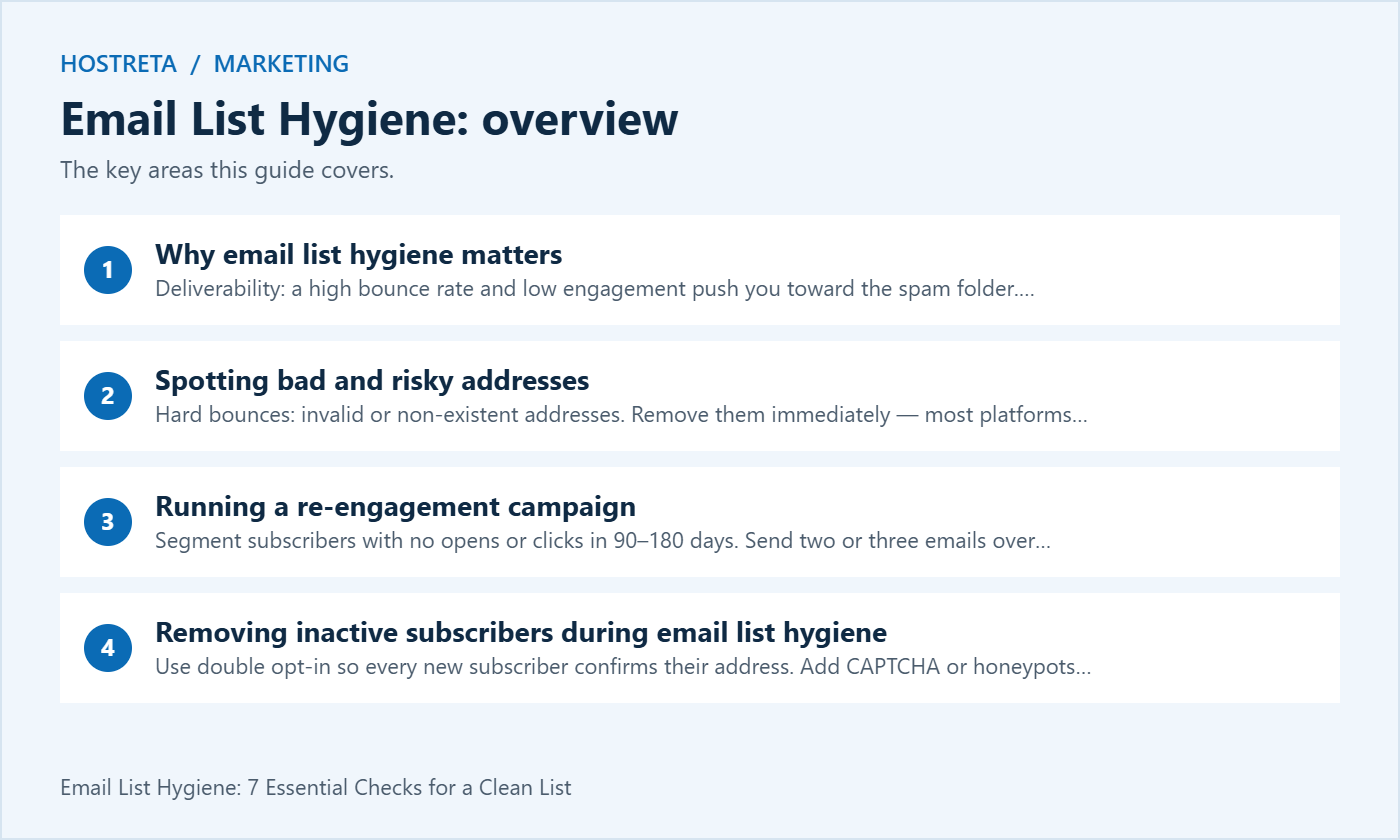
A large email list is useful only when it contains people who expect your messages. Invalid addresses, complaints and poorly managed consent can damage the value of that audience. Email list hygiene is the habit of regularly removing the addresses that hurt you.
This guide explains why list hygiene matters, how to spot bad addresses, how to run a re-engagement campaign, when to remove inactive subscribers, and how to keep your list clean long term.
Mailbox providers consider multiple signals when filtering mail. Review delivery failures and complaints alongside meaningful engagement. An open-tracking event is not a reliable record of an individual reading a message.
gmial.com, hotmial.com, or missing dots.info@ or admin@ that are often shared or unmonitored.A verification service may identify technical risks, but it cannot prove that a person consented or guarantee inbox placement. Do not automatically correct an address and start sending to a different person.
Before you remove inactive subscribers, give them a chance to stay:
Writing emails people want to open helps here too — see How to Write a Newsletter People Actually Open.
Apply a documented inactivity policy, accounting for subscription age, sending frequency and tracking limitations. Eligible unengaged contacts may be suppressed or removed. Suppressing (instead of deleting) keeps a record so you don’t accidentally import them again.
It feels painful to shrink your list, but there is no guaranteed improvement in inbox placement. Measure complaints, delivery errors and useful responses after each change.
Choosing a platform with good hygiene tools? Compare options in Best Email Marketing Platforms for Small Businesses.
Good content needs a fast site and steady promotion. Marketgoo gives step-by-step SEO recommendations, and SocialBee schedules social posts across platforms. For hosting, Kawedma WordPress hosting and managed WordPress hosting powered by Rocket.net keep pages quick, and the AI SiteBuilder from Hosting.com helps launch simple sites fast.
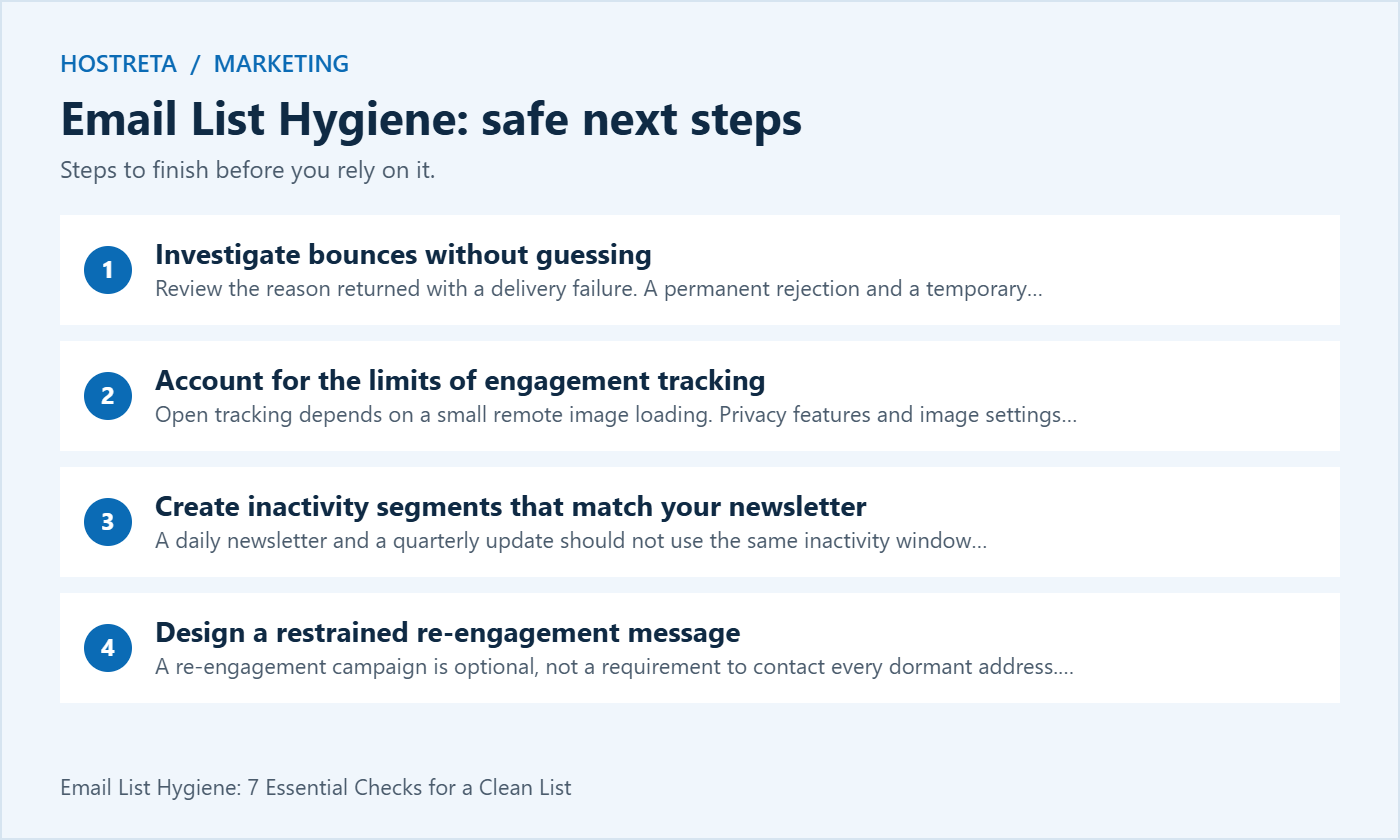
Before checking engagement, establish why each person is on the list. Record the subscription source, date and the type of content they requested. A checkout email address and a newsletter subscription are not automatically the same permission. Keep transactional communication and marketing preferences distinct in your systems so a list cleanup does not remove essential order communication or add someone to an unrelated campaign.
If an old file lacks a clear subscription history, do not assume that its age proves permission. Investigate the source and your platform’s rules before sending. A purchased or scraped address is not made suitable for marketing simply because a verification tool marks it deliverable. Email list hygiene includes the decision not to send when the basis for contact cannot be established.
For new forms, describe what subscribers will receive and how often you plan to write. Keep the promise realistic. A person who requests a monthly educational newsletter may not expect daily promotions. Clear expectations help you interpret later inactivity: a subscriber can remain interested in the original topic while ignoring a different campaign.
An unsubscribe should affect future marketing sends, including scheduled campaigns, automations and later imports. Check how your platform applies suppression across audiences. A contact can exist in a customer database without being eligible for a newsletter. Document that distinction so another team member does not reactivate the address merely because the person previously purchased something.
Keep the information needed to prevent unwanted re-imports according to your organization’s retention and privacy process. Archiving, suppression and permanent deletion can behave differently. Read your platform’s documentation before choosing an action. A cleanup for inactivity is not the same operation as responding to a person’s deletion request.
When moving to another email platform, include the suppression history in the migration plan. Importing only active-looking addresses while losing unsubscribe records can create avoidable mistakes. Test the destination system with a small controlled sample and confirm that an ineligible contact remains excluded before preparing a broad campaign.
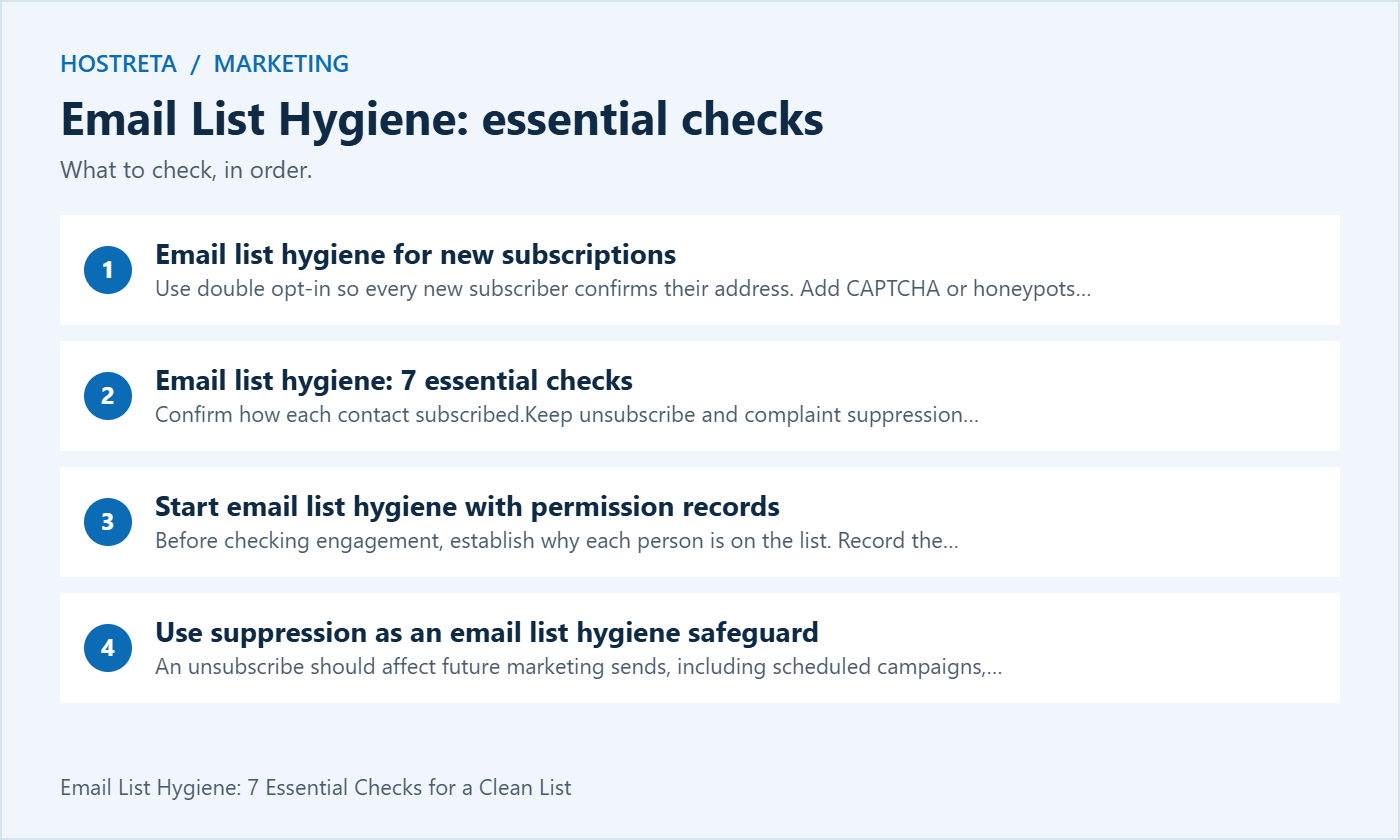
Review the reason returned with a delivery failure. A permanent rejection and a temporary failure require different handling. Your platform may already suppress certain addresses automatically. Understand that behavior before creating a second cleanup workflow that could conflict with it. Do not repeatedly resend a campaign to the same rejected addresses in an attempt to force delivery.
For temporary errors, look for patterns. A failure affecting many addresses at one mailbox provider may indicate a sender configuration or reputation issue rather than hundreds of suddenly invalid subscribers. Compare the error text, timing and sending domain. Email list hygiene should support diagnosis, not hide a systemic problem by deleting every affected contact.
Role-based addresses are not automatically invalid. A person may intentionally subscribe through a shared business mailbox. Review the permission and observed behavior instead of removing every address beginning with info or support. Treat technical risk flags as inputs for review, not as proof that a real subscriber should be discarded.
Open tracking depends on a small remote image loading. Privacy features and image settings can make that event differ from an actual human read. A person who reads plain text or blocks images may look inactive, while automated loading can create an open event without a person reading. Do not make email list hygiene depend on a single open-rate threshold.
Clicks are useful but also need context. Security scanning and automated activity can affect campaign metrics. Consider the platform’s bot filtering and compare clicks with meaningful outcomes such as replies, preference updates or completed actions. Avoid treating every recorded click as evidence of renewed interest.
Use the information your business already has appropriately. A recent customer request, a preference confirmation or a relevant account action can tell a different story from a missing tracking pixel. Apply a consistent policy and avoid collecting extra personal information merely to label subscribers. Email list hygiene works best when it uses proportionate, understandable signals.
A daily newsletter and a quarterly update should not use the same inactivity window without review. Count the opportunities a subscriber had to engage, not just the days since the last event. Someone who subscribed yesterday should not be grouped with an address imported years ago, even if neither has clicked a campaign yet.
Separate new subscribers, established readers and contacts with an unclear history. Then review each group’s actual sending history. If a segment has received very little relevant content, silence may reveal a content or scheduling issue rather than a reason to remove everyone. Email list hygiene should prompt you to improve the subscription experience as well as reduce risk.
Write the segment rules in plain language before implementing them. Include the time window, eligible subscription status, excluded complaint or unsubscribe states and the actions that count as engagement. Have another team member read the rules and explain them back. This catches ambiguous conditions before they affect a large audience.
A re-engagement campaign is optional, not a requirement to contact every dormant address. First confirm that the person is still eligible to receive marketing and that your platform permits the planned send. Exclude unsubscribed contacts, known permanent failures and addresses with an unclear permission history. Never use a re-engagement campaign to bypass an existing suppression.
Keep the message honest and useful. Remind the person what they subscribed to, offer a clear way to update preferences and make leaving easy. Avoid misleading subjects, false urgency or statements that imply a personal relationship you do not have. Email list hygiene is an opportunity to respect preferences rather than pressure someone into staying.
For example, an educational newsletter could say that it has been a while since the reader interacted and ask whether they still want practical website tips. Provide a straightforward preference link and an unsubscribe option. Do not require a purchase or a social follow to retain a subscription. Keep the decision about email separate from unrelated promotional goals.
Limit the sequence and define its end before sending. Repeatedly contacting a quiet segment defeats the purpose of reducing unnecessary mail. After the planned review, apply the documented policy and record the outcome. A person who does not respond should not simply be recycled into the next identical sequence.
Review the live form from a visitor’s perspective. Confirm that the description is clear, the confirmation process works and the person receives what was promised. Test the welcome message and preference links with an account you control. A broken confirmation flow can make a legitimate audience appear uninterested.
Consider protections against automated submissions that suit the form and platform. A confirmation step, validation and appropriate anti-bot controls can reduce unwanted entries, but no single feature eliminates every problem. Review patterns in new signups and investigate unexpected spikes. Do not judge success only by how quickly the subscriber count grows.
If you collect addresses at an event or through a partner, document how the subscription was requested and what the audience was told. Keep that source separate for evaluation. Email list hygiene becomes harder when every source is mixed into one undifferentiated import and nobody can explain why contacts were added.
Record the campaign date, audience, delivered count, delivery failures, complaints, unsubscribes and meaningful responses. Include a note about changes to content or sending frequency. This gives context to trends. A higher open percentage after suppressing contacts does not, by itself, establish that more people benefited from the newsletter.
Compare similar campaigns and audiences. If one send targets active customers and another targets an old newsletter segment, their results are not a clean before-and-after test. Keep the segments identifiable and explain the difference when reporting to the business. Email list hygiene should make reporting more honest rather than produce a flattering metric.
Assign an owner and a review date for unresolved issues. If a provider-specific bounce pattern needs investigation, record the next action instead of repeatedly marking the list as cleaned. A small review sheet with clear ownership is more useful than a large report nobody acts on.
Begin by reviewing automatic suppression and recent errors. Confirm that unsubscribe links and preference pages still work. Then inspect the acquisition sources for unusual activity. Look at inactive segments using the documented rules, accounting for subscription age and the number of relevant campaigns sent.
Next, decide whether any eligible segment warrants a limited re-engagement effort. Prepare the content, review the exclusions and test the links. After the review period, apply the established policy and document the change. Finish by checking that future imports and automations respect the updated statuses.
Keep the process proportionate to your audience. A small newsletter may need a simple checklist and a careful review, while a larger organization needs coordination between marketing, support and data owners. The essential email list hygiene habit is consistency: make decisions you can explain and repeat without accidentally restoring people who opted out.
No. Review tracking limitations, subscription age and other relevant activity first. Choose an action using your platform’s documented behavior and your organization’s policy. Do not confuse an imperfect measurement with proof that a person never read your messages.
No. A technical check cannot establish a person’s subscription preference or promise delivery to the inbox. Review why the address is present and continue to monitor campaign quality. Email list hygiene is an ongoing operating process, not a one-time certificate that a list is safe to contact.
Confirm that subscription history, relevant engagement context and suppression states transferred correctly. Test campaign exclusions before using the full audience. Keep the previous records available through the approved migration and retention process so unexplained differences can be investigated.
Review Mailchimp’s Mail Privacy Protection explanation for tracking limitations, and its contact deletion and archiving guidance before choosing a cleanup action. Consult your own platform for the exact controls.
When someone else takes responsibility for the newsletter, walk them through the current subscription states and review rules. Show them where consent sources are documented and how the platform prevents an excluded contact from entering a campaign. Email list hygiene should remain consistent when a new employee or contractor starts managing sends.
Use a test contact you control to demonstrate the preference process. Confirm which message types stop after an unsubscribe and how the system displays that state. Keep transactional messages separate where the platform supports that distinction. Do not change real subscribers merely to demonstrate the interface.
Write down why a segment was suppressed, when the review occurred and which rule was applied. If the team later questions a smaller audience, those notes explain the decision without relying on someone’s memory. Email list hygiene is easier to maintain when the rules and results are visible to the people responsible for sending.
Finally, review any planned imports before they are scheduled. Ask where the addresses came from and whether suppression checks will run. A brief review can prevent months of careful email list hygiene from being undone by an old spreadsheet that appears to contain useful leads.
We may earn a commission on purchases made through these links, at no extra cost to you.
Don’t miss the chance to participate in the biggest giveaway of this year.