Marketing

Grow Your Email List: 7 Essential Checks for a Great Holiday Campaign
When Black Friday arrives, ad costs spike and social reach is unpredictable. An email list gives you a direct permission-based communication channel, subject to provider costs, recipient choices, and delivery limits. A new address does not guarantee a future inbox placement or sale. The weeks before the rush are the best time to grow your email list.
This guide covers why your list matters for the holidays, early access and waitlist offers, opt-in placements that convert, promoting signups on social, and nurturing subscribers before the sale.
Starting from zero? See Email Marketing 101: Build Your First List.
The strongest pre-sale incentive isn’t a generic newsletter — it’s privileged access:
Make the promise specific and keep it. A simple landing page with one headline, a few bullet points, and an email field makes the offer easier to understand; measure its results with your audience rather than assuming a guaranteed conversion improvement.
Keep forms to one field — the email address — unless you have a strong reason to ask for more.
An email list should grow through a clear promise and a maintained permission process. The useful goal is a group of people who understand what they signed up for and can change their preference easily. A larger raw address count can be misleading if it includes mistakes, unconfirmed requests, duplicates, or people who no longer want the messages.
Start with the audience and the benefit you can actually deliver. This guide describes a campaign workflow rather than sending messages or making a legal conclusion for every region. Review the applicable requirements and platform terms with the responsible owner before collecting or using addresses.
Explain who sends the messages, what subscribers receive, and the relevant campaign timing. An email list for early access should deliver that access as advertised. Do not invent scarcity or promise an extra discount that the store’s coupon rules do not support.
Keep the signup wording consistent across the landing page, popup, checkout choice, and welcome message. If a campaign subscription also includes later marketing, make that scope understandable. A visitor should not need to interpret vague phrases such as special updates to know what will arrive.
Keep marketing preferences distinct from a purchase, receipt, or support request. An email list should not automatically absorb every address that appears in a contact form. Record the approved basis and wording for each collection path, with the relevant time and source.
The UK ICO’s electronic-mail marketing guidance explains consent and conditional alternatives in that jurisdiction. Requirements differ by context and region; do not treat a purchase or a publicly available address as universal permission for every marketing use.
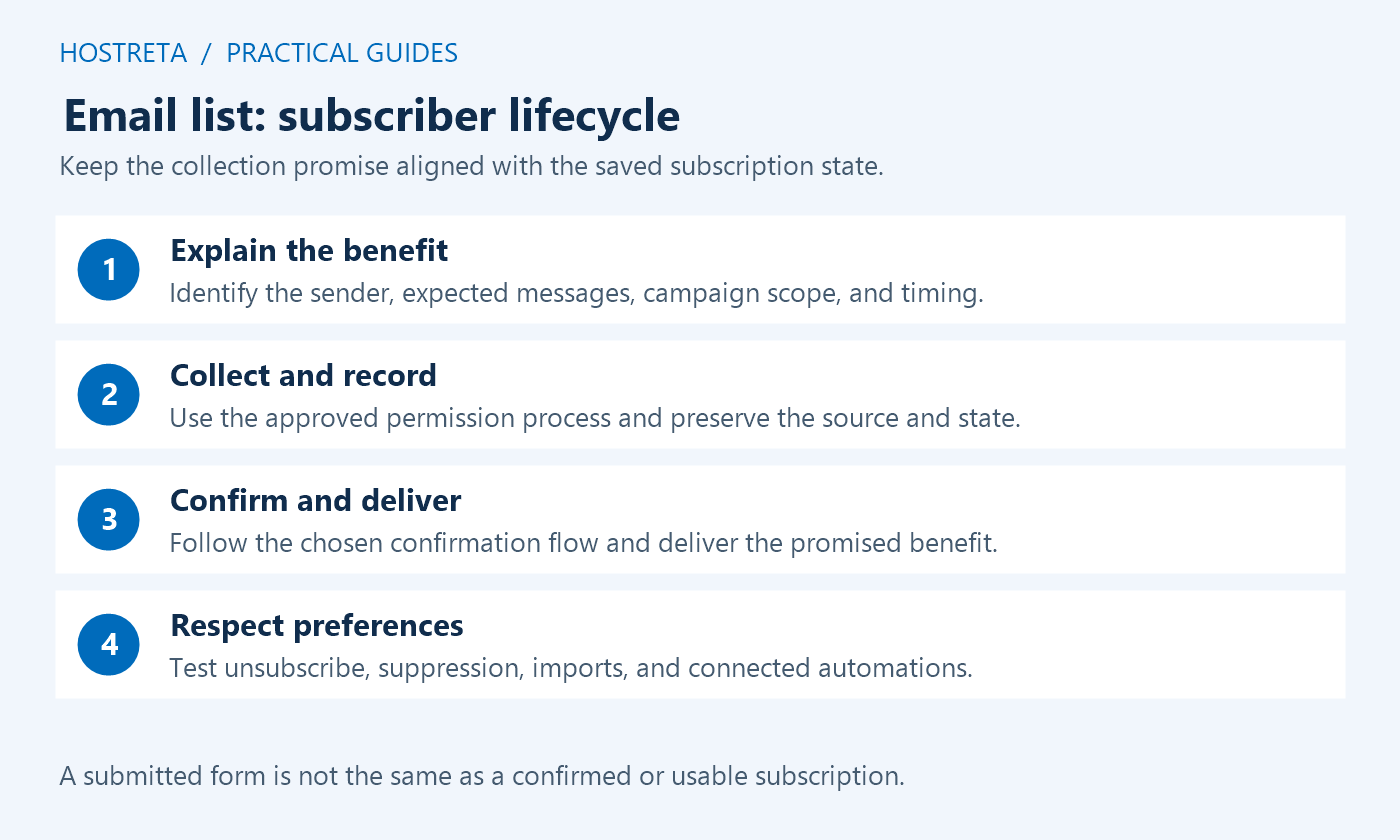
Submit a synthetic address and inspect the actual destination record. An email list integration should preserve the intended audience, subscription state, source, and any required preference evidence. A form’s success message alone does not prove that the correct record was saved.
Test a valid address, an invalid entry, a duplicate, and an address already unsubscribed. Check how the platform handles each state. Do not silently resubscribe someone through a store import or integration merely because the address exists in another system.
Double opt-in adds an address-confirmation step that can reduce some accidental or unwanted subscriptions. An email list still needs clear collection wording and appropriate records; confirmation is not a substitute for understanding the purpose or the applicable rules.
Mailchimp documents single and double opt-in workflows. Verify the chosen method in your actual integration. Test the pending state, confirmation link, expired or repeated link behavior where relevant, and the point at which the promised benefit is delivered.
Use a synthetic subscriber to follow the unsubscribe path and verify the saved state. An email list should have a clear way to stop marketing without forcing an unnecessary account login. Keep suppression behavior consistent across forms, imports, automations, and other connected tools.
Mailchimp’s unsubscribe documentation describes its supported process. Keep the relevant suppression evidence needed to honor preferences. Removing a contact from one visible segment is not the same as ensuring another automation cannot send to it.
Write a welcome sequence that confirms the promise and helps the subscriber recognize the sender. An email list is more useful when messages are expected and relevant. Avoid a sudden high-volume burst from a neglected sending setup immediately before the sale.
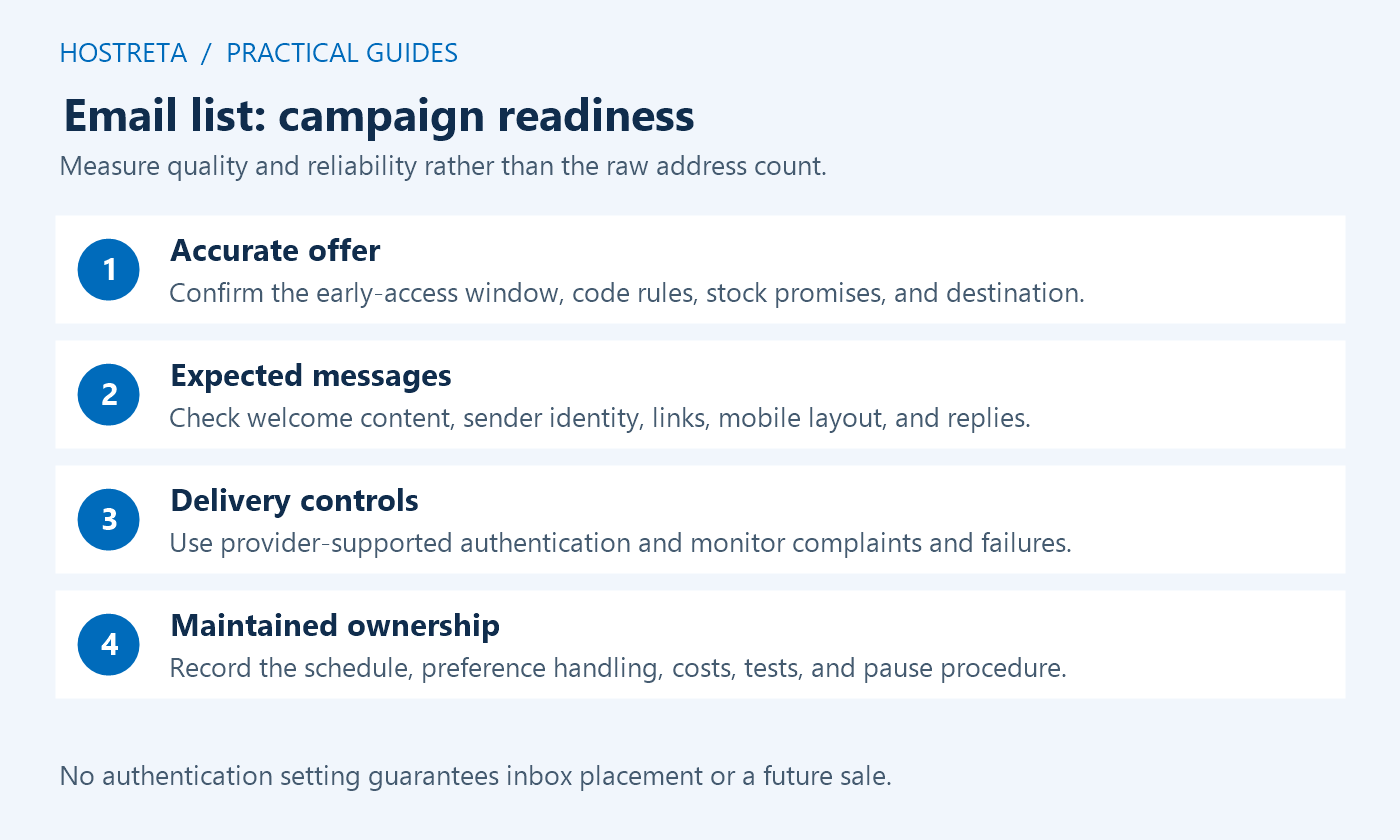
Use the sending provider’s supported domain authentication and monitoring. Check test messages, links, mobile layout, sender identity, and reply handling. Authentication can support delivery, but no setting guarantees that every recipient system places a campaign in the inbox.
Track confirmed subscriptions, source, engagement signals appropriate to the decision, complaints, bounces, and unsubscribes. An email list growth report should distinguish raw submissions from usable subscriptions. A popup that captures many mistaken addresses may perform worse operationally than a quieter but clearer form.
Assign an owner for campaign wording, integrations, preferences, provider costs, and list maintenance. Review the setup after changes to the store or platform. Keep a documented way to pause a faulty automation and correct records without overriding legitimate opt-outs.
| Case | Expected evidence |
|---|---|
| New valid subscriber | Correct audience, source, state, and promised next step |
| Invalid address | Understandable validation without misleading success |
| Duplicate signup | Defined behavior without unnecessary duplicate messages |
| Pending confirmation | No unintended campaign inclusion before the chosen confirmation step |
| Existing opt-out | Supported preference handling rather than silent resubscription |
| Unsubscribe | Saved suppression and no later marketing from connected flows |
| Integration failure | Visible bounded failure and an owner who can respond |
Run the matrix before promoting the email list widely. Use test records clearly separated from real subscribers and review actual platform states. A polished landing page is only the front of a workflow that also includes data, preferences, messages, and support.
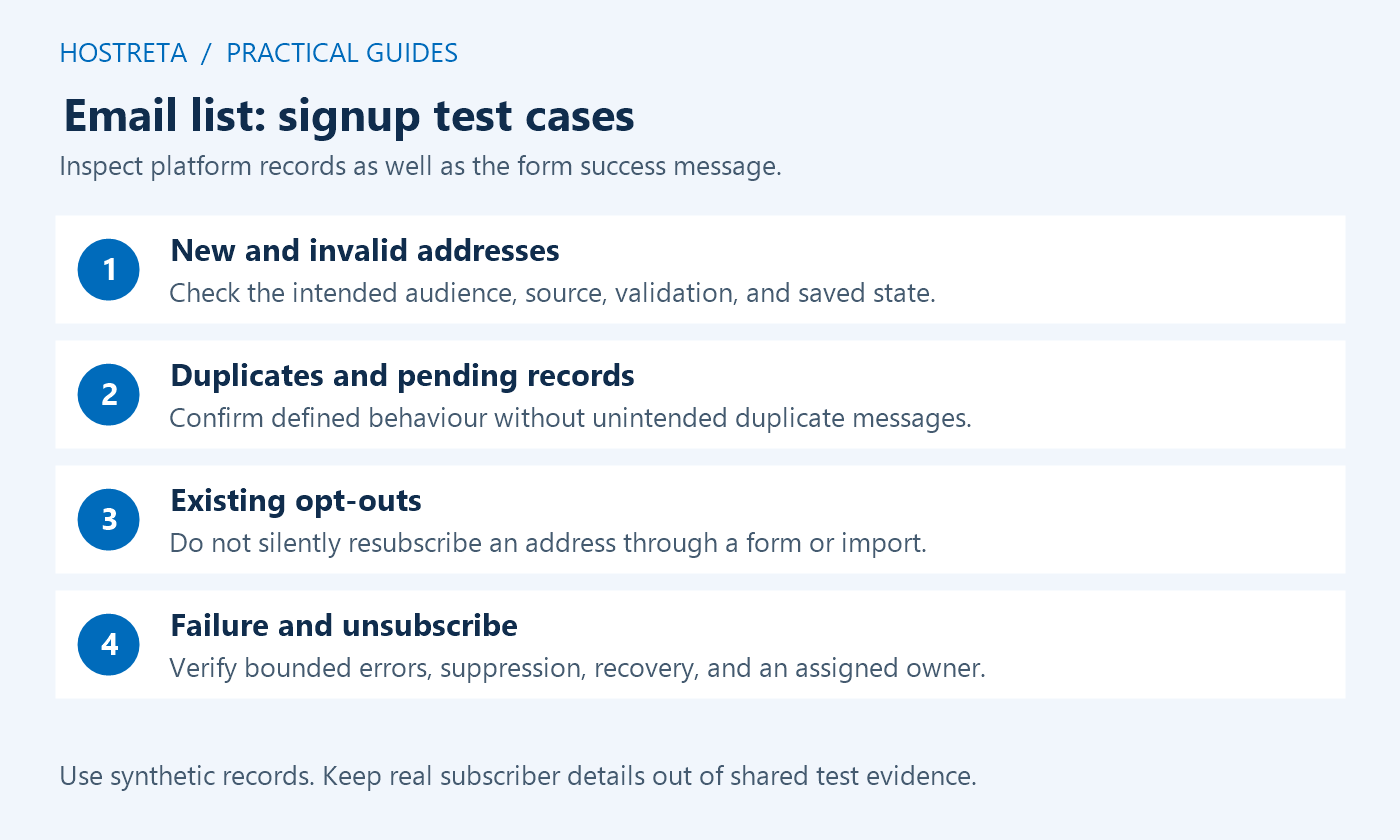
Early access, a useful guide, a product announcement, or a relevant discount can be appropriate when the benefit matches the audience. Choose one that the business can fulfill reliably. A large giveaway can attract people interested only in the prize, so evaluate subscriber quality rather than raw volume.
Keep the email list promise specific. If early access is 24 hours, confirm the store, landing page, and campaign schedule actually implement that window. If stock is limited, describe the real limitation without implying a guaranteed item reservation unless that is truly provided.
Test the incentive delivery and access conditions. A code should work for its intended products and audience, and a download link should reach the approved file. Document what happens when someone confirms after the campaign has ended so the experience remains honest.
Place the form where it supports the task without blocking essential content or checkout. An inline form can work well near relevant guidance, while a banner may suit a clear campaign announcement. Do not assume an exit popup works the same on touch devices as on a desktop.
Use a clear label, keyboard access, visible focus, readable text, and useful error messages. An email list form should remain understandable with enlarged text and on a narrow screen. Test the close control for any overlay so a visitor can continue without subscribing.
Collect only fields needed for the stated purpose. An email address alone may be enough; additional preferences can be useful when they drive an actual segmentation decision. Explain optional fields and avoid asking for personal details merely because the platform offers them.
Keep transaction processing separate from marketing enrollment. A customer may need an order receipt without wanting future offers. Review the approved preference process and test the active checkout implementation, including any integration that synchronizes buyers to the email platform.
A back-in-stock or product waitlist request can have a narrower scope than a general email list. Explain the distinction and do not assume the requester agreed to every later campaign. Keep records and automations aligned with the promise made at collection.
Check duplicate and existing-contact behavior. If the store and signup form use different audiences or tags, confirm which system owns the subscription state. An older import should not overwrite a newer refusal or unsubscribe.
Use relevant public channels and describe the benefit accurately. A profile link, existing permitted newsletter, helpful content, or an approved ad can lead interested readers to the page. Keep the campaign destination stable and test it on mobile before promoting it widely.
Use campaign labels to compare sources without embedding private identifiers. An email list source report should support decisions about where useful subscribers come from. Avoid collecting unnecessary individual details just to make attribution look more precise.
Do not scrape public contact details or buy a list as a shortcut to growth. Mailchimp’s audience requirements prohibit purchased, rented, and scraped third-party lists on its service. Review the actual provider’s terms and applicable requirements rather than accepting a seller’s broad permission claim.
Send the expected welcome message through the supported platform workflow and identify the sender clearly. Link to the promised benefit and explain what comes next. Keep an appropriate reply or support route so subscribers can resolve a missing code or access problem.
Plan the number and purpose of later messages. An email list does not need a daily teaser merely because the calendar is approaching a sale. Match the cadence to the original expectation and the audience’s response, with a clear way to change preferences.
Review complaints and failures promptly. A new campaign can reveal a broken form, an unexpected audience import, or confusing wording. Pause and investigate meaningful problems rather than simply sending again to everyone who did not open.
Open and click metrics have limitations from privacy features, automated scanning, and measurement design. Do not treat one unrecorded open as proof that a person is inactive. Use multiple appropriate signals and the provider’s guidance when deciding how to maintain the email list.
Track the outcome relevant to the campaign, such as confirmed subscription or a completed permitted conversion. Distinguish a link click from a purchase and a submitted form from an active subscriber. Keep definitions stable so source comparisons remain meaningful.
Compare quality over a suitable period instead of declaring a winner from a tiny sample. A clearer form may produce fewer addresses while reducing complaints and improving the relevance of the audience. State the actual observed result rather than promising a universal conversion lift.
Review who may export, import, segment, or administer subscriber data. Keep real addresses and preference records out of public screenshots, shared demos, and source repositories. Use synthetic examples when asking for implementation support.
Define retention for pending requests, inactive records, campaign tags, and operational evidence according to the approved policy. An email list needs enough suppression information to honor choices, but that does not justify retaining unrelated personal data forever.
Review connected systems after migrations or provider changes. Exporting addresses alone may omit preference history or suppression state. Plan the transition and verify representative records before the next send rather than assuming all contacts can be reactivated.
Keep the promise, approved form wording, collection paths, platform mapping, confirmation choice, suppression behavior, message schedule, test results, and owner in a concise record. An email list campaign is easier to maintain when another person can understand how a subscriber enters and leaves the flow.
If you need technical help with forms, landing pages, or integrations, KAWEDMA offers website development and hosting services. Provide the requirements and synthetic test cases, then request a demonstration that includes failures and opt-outs as well as successful signup.
No. Permission, relevance, valid addresses, maintained preferences, cost, and useful outcomes matter. Separate raw submissions from confirmed subscriptions and investigate sources that produce complaints or poor-quality records.
No. It adds a confirmation step, but the collection wording, purpose, records, platform terms, data handling, and applicable rules still require review. Use the method as part of a maintained process rather than a universal legal guarantee.
Preserve and honor the applicable preference through supported platform behavior. Do not silently reactivate an opt-out because another system still contains the address. Test suppression across imports, forms, and automations.
The email list promise is accurate, signup and confirmation work, preferences are respected, messages and links pass tests, data handling is appropriate, and ownership is clear. Keep the results and review changes before a major send.
Review the accepted setup again when the offer changes, because new wording or integrations can alter what subscribers reasonably expect from the campaign.
We may earn a commission on purchases made through these links, at no extra cost to you.
Don’t miss the chance to participate in the biggest giveaway of this year.