Reviews

Domain Registrars: 7 Essential, Safe Selection Checks
Domain registrars manage the registration relationship for your domain. Your domain name is the foundation of your website, your email, and your brand. If someone steals it or it expires by mistake, everything built on top of it stops working. That’s why choosing among the best domain registrars isn’t just about the cheapest first-year price — it’s about who you trust to guard your most important digital asset.
This guide covers what makes a registrar trustworthy, the security and privacy features to require, how popular registrars compare, and how to pick one.
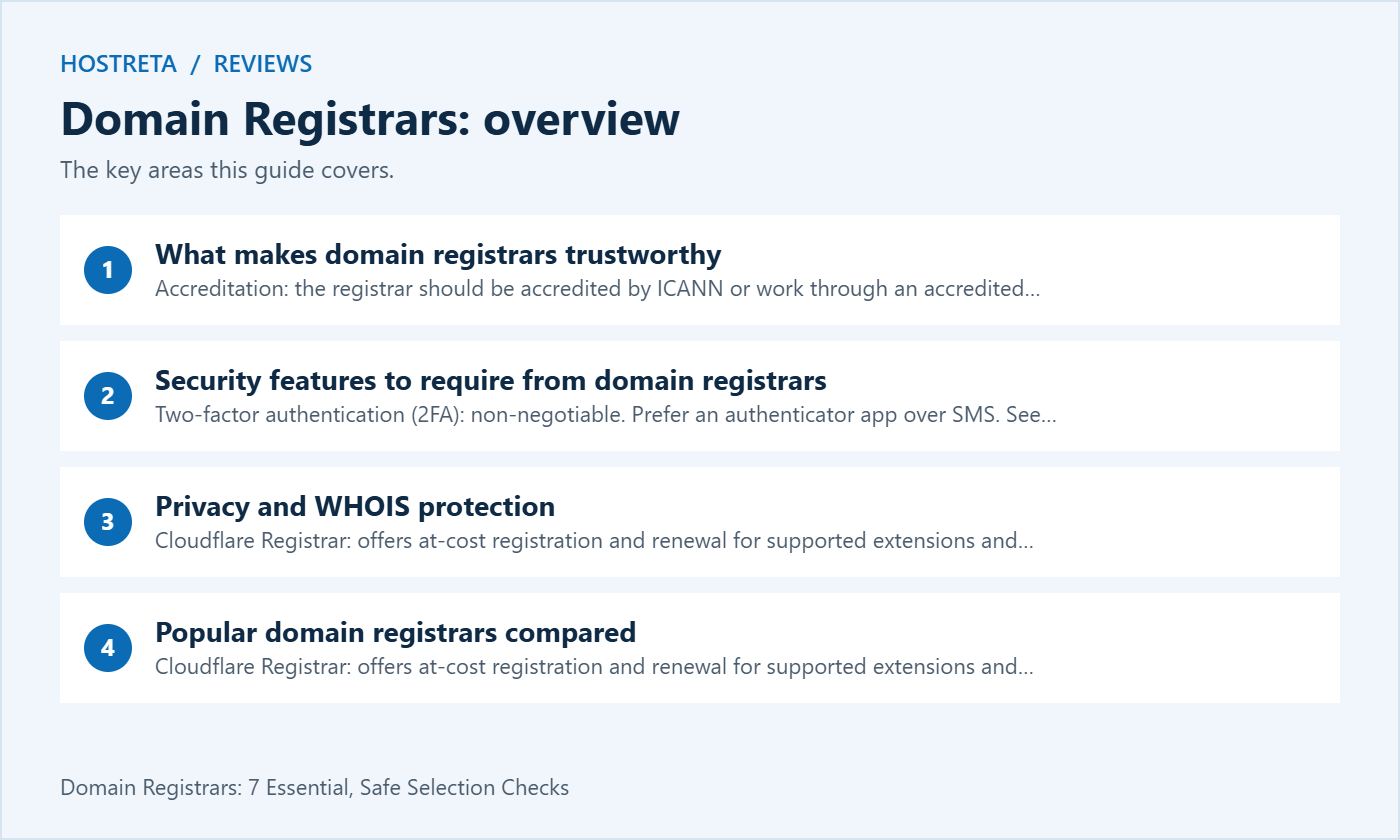
Public WHOIS records used to display your name, address, phone number, and email for anyone to see. Today, many registries redact personal data, but WHOIS privacy (also called domain privacy) is still worth having. It replaces your contact details with the registrar’s proxy information, which cuts down on spam and scam emails.
Check privacy eligibility and its ongoing price for the exact extension. Registry rules and service terms vary; do not assume every domain can use the same privacy feature.
Prices and features change, so always check current pricing. For a deeper look at two of the biggest names, see Namecheap vs GoDaddy: Where to Buy Your Domain.
Already registered elsewhere? Moving is straightforward — see How to Transfer a Domain to Another Registrar.
A fast, well-supported host makes every WordPress task smoother. Kawedma WordPress hosting and managed WordPress hosting powered by Rocket.net include staging sites for safe testing, while shared hosting from Hosting.com or Kawedma shared hosting suit smaller sites. Protect the site with an SSL certificate and automatic backups from CodeGuard.
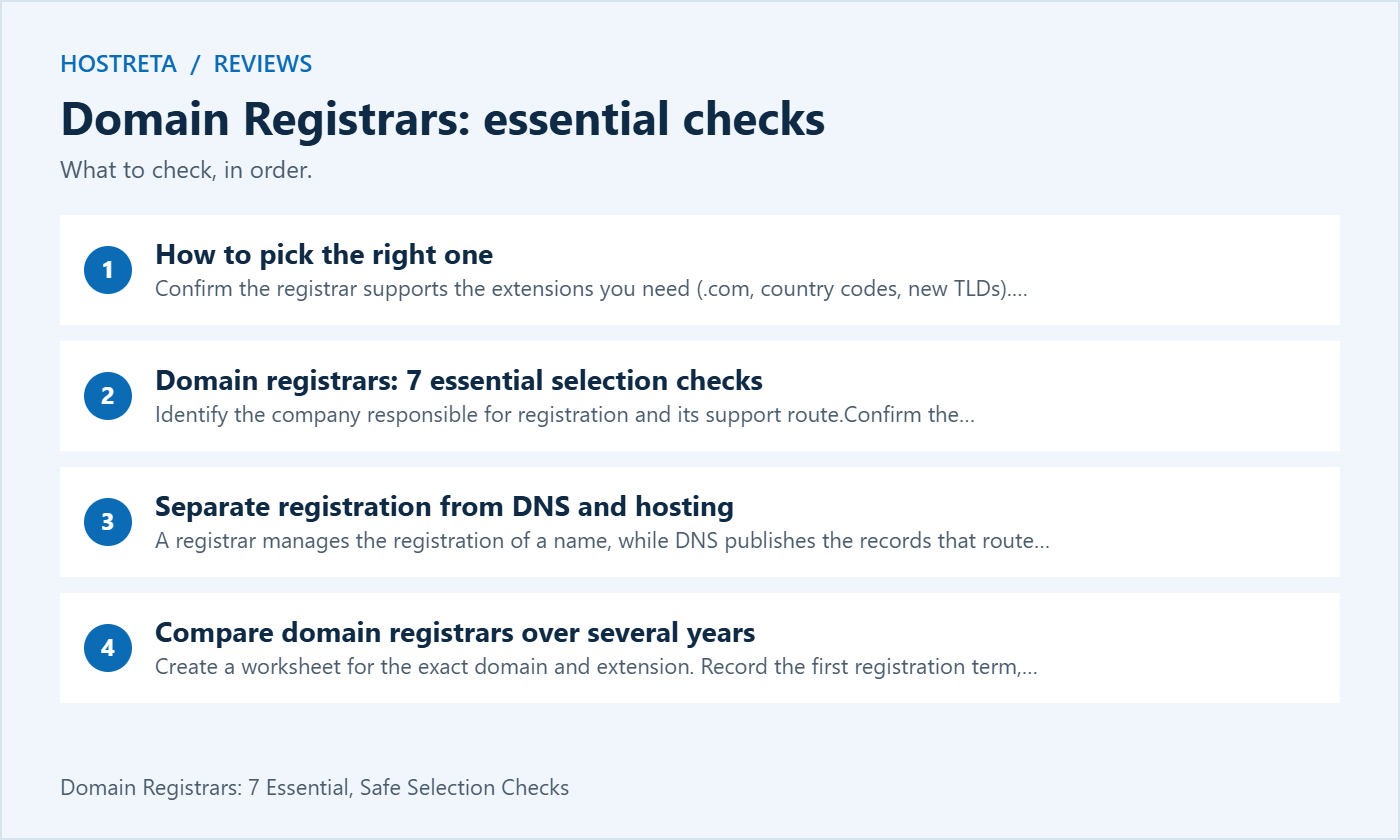
A registrar manages the registration of a name, while DNS publishes the records that route visitors and mail. Hosting runs the website or application. One supplier can provide all three, but they remain separate functions. Understanding the distinction helps you compare domain registrars without assuming that moving registration always requires moving the website.
Before buying or transferring, record who currently provides each service. Include the authoritative nameservers, the website destination and the mail provider. A registrar transfer can be straightforward when DNS remains stable, but changing nameservers at the same time introduces another migration. Keep a copy of the zone and a tested plan for any intended change.
Ask whether the registrar requires its own DNS service. Cloudflare’s registration documentation states that its registered domains use Cloudflare nameservers. That can fit many websites, but it should be a deliberate choice. Check the requirements of your actual hosting or application provider before choosing domain registrars on headline cost alone.
Create a worksheet for the exact domain and extension. Record the first registration term, renewal price, transfer price, privacy cost and any optional protection package. Include applicable currency and tax information. A cheap first year can be useful, but it does not describe the ongoing cost of a name your business intends to keep.
Use the provider’s current checkout and renewal information when comparing domain registrars. Extension prices differ and premium names can have different renewal terms from ordinary registrations. Do not assume that every name ending in the same extension has the same lifetime cost. Save a dated copy of the relevant terms when you make the decision.
Include recovery fees in the review, even though the goal is to avoid needing recovery. The normal renewal price and a redemption restoration charge are different items. Ask how the provider communicates expiry, what happens after a failed renewal and which stages are governed by the registry. Do not treat a grace period as an extra free registration term.
| Cost item | Question | Record |
|---|---|---|
| Registration | Which term does the promotion cover? | Initial amount and years |
| Renewal | What is the current standard renewal? | Ongoing amount and currency |
| Privacy | Is the extension eligible? | Coverage and annual cost |
| Transfer | What does the fee include? | Conditions for this extension |
| Restoration | What happens after expiry? | Recovery route and fees |
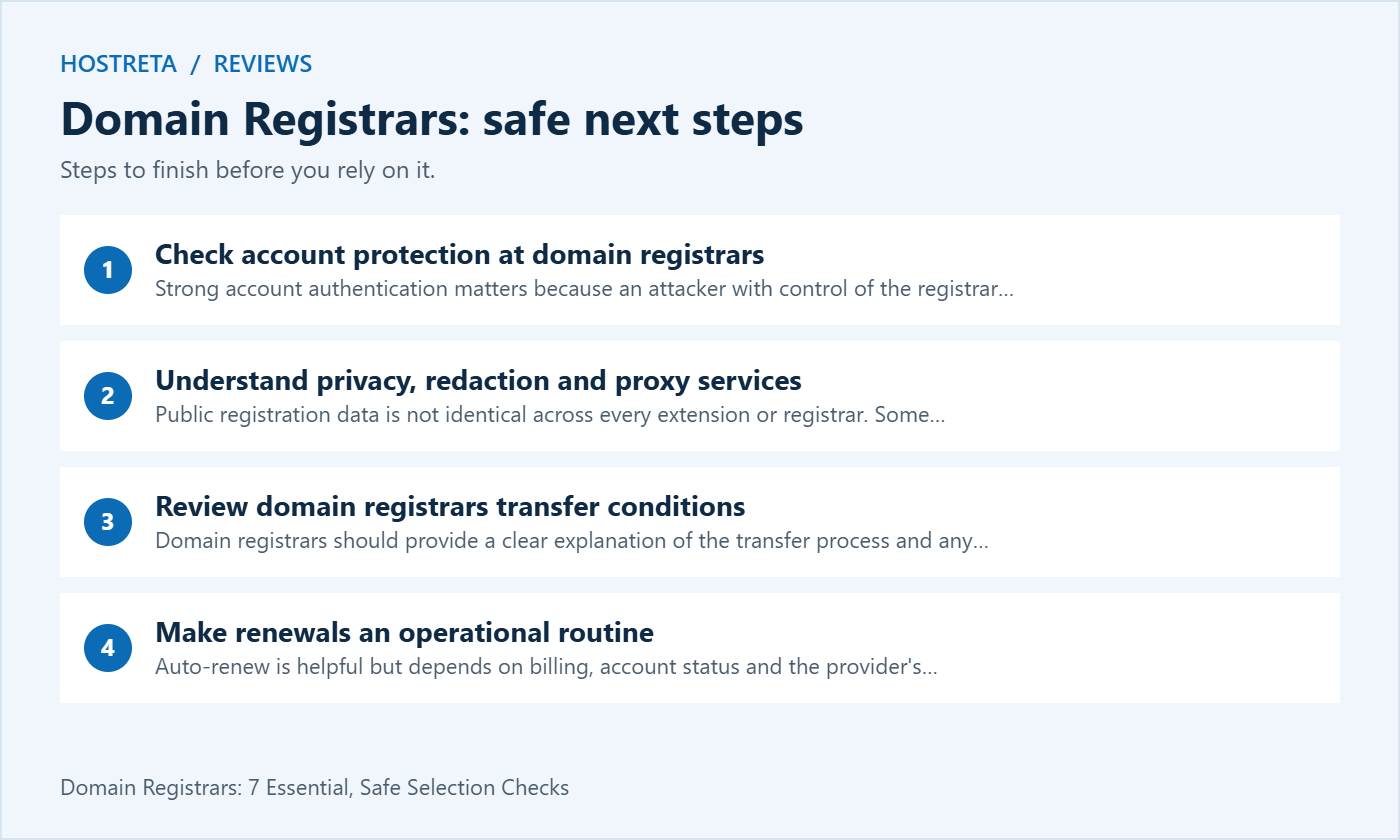
Strong account authentication matters because an attacker with control of the registrar account may be able to affect both the website and email. Review the authentication methods actually supported, recovery controls and login alerts. Protect the email account used for recovery as carefully as the registrar account itself.
A transfer lock is one control, not a complete security system. Ask which changes it restricts and how an administrator unlocks a domain legitimately. Some providers offer additional registry-level or account-level protections, but names and coverage vary. Compare the documented behaviour and recovery process rather than assuming every product called protection does the same thing.
For a team, prefer access arrangements that do not require sharing the owner’s password. Check whether domain registrars support delegated roles or separate user access appropriate to your organisation. Give developers the access required for their work while keeping ownership and billing decisions with the business. Remove obsolete access when a project or employment relationship ends.
Keep recovery codes securely and maintain a documented recovery route. Do not store the only recovery information inside a mailbox that depends on the same domain. If that domain stops working, you still need a way to contact support and prove control. Test that responsible staff know where the recovery information is held.
Public registration data is not identical across every extension or registrar. Some information may be redacted under applicable policies; some privacy or proxy services substitute contact details. Ask what the selected service actually hides, how legitimate correspondence reaches you and which circumstances can result in disclosure.
Namecheap describes privacy availability for eligible extensions. That eligibility qualifier matters. Country-code domains may follow their own registration rules, and a feature advertised on a provider’s homepage does not establish the policy for every name in its catalogue. Verify the extension you intend to register.
Privacy masking does not make the registrant anonymous to the provider or remove the obligation to supply accurate registration information. Keep the account details current and respond to legitimate verification notices through the provider’s known dashboard. Treat unsolicited renewal or verification messages cautiously and avoid using links from an unfamiliar message to enter credentials.
Domain registrars should provide a clear explanation of the transfer process and any restrictions relevant to your name. New registrations, recent transfers or contact changes can affect eligibility under applicable rules. Check the actual domain status and timing rather than promising a same-day transfer based on a generic tutorial.
The ICANN transfer FAQ explains common questions for covered domain registrations. Country-code extensions can have different procedures. Ask the receiving provider to confirm its requirements before unlocking a domain or requesting an authorisation code. Treat that code as sensitive account information.
A registrar transfer is usually a planned administrative operation, not the best first response to an unexplained website outage. If DNS or hosting is broken, diagnose that problem directly. Changing providers while ownership or contact information is unresolved can complicate recovery. Stabilise essential services and gather the relevant records before making several changes at once.
Auto-renew is helpful but depends on billing, account status and the provider’s processing. Add an independent expiry reminder and verify the result after the renewal attempt. A saved card can expire or be declined. The absence of an obvious error message is not proof that a registration has been extended.
ICANN’s renewal guidance describes reminders and expiry questions for covered registrations. Read the registrar’s own terms as well. Put the responsible owner, payment method review and notification address in a maintenance checklist. Shared ownership without a named person often becomes nobody’s task.
For agencies, separate client domains clearly and document who the registrant is. Registering a client’s domain entirely under a developer’s personal account can create a difficult handover later. Decide who receives renewal notices and who pays before the first invoice. Domain registrars are easier to evaluate when the business has already clarified its own responsibilities.
Before ordering, ask how you would report unauthorised changes, recover account access or resolve a failed renewal. Check available channels and hours for the selected plan and region. A general sales response does not prove that an urgent account case will be handled through the same channel.
Keep expectations proportionate. Support may need identity verification and cannot necessarily reverse a completed transfer or restore an expired name immediately. A provider that explains its limits clearly may be easier to work with than one making broad promises. Document the correct escalation route so you do not search for it during an outage.
Compare domain registrars using the quality of their documentation and the clarity of their answers. Useful questions include how to export DNS, where to find the transfer code, how renewal notices are delivered and what happens when the primary administrator leaves. These details affect everyday maintenance more than a flashy dashboard screenshot.
If you want a supplier for domain registration alongside hosting and business email, KAWEDMA offers relevant services to review. Ask which company sponsors the registration, which extensions are available and how renewals, privacy and transfers work for your chosen name. Confirm the actual terms before ordering.
Do not assume KAWEDMA is directly ICANN accredited or that every extension includes free privacy unless the provider confirms it. A reseller relationship can still be a suitable arrangement when responsibilities and support are clear. Apply the same ownership, security and ongoing-price checklist that you use for other domain registrars.
For a single small-business domain, simple administration, clear renewal pricing and reliable recovery may be the main priorities. For an agency with many clients, access delegation and ownership records can matter more. For a business with special DNS requirements, the ability to use the intended nameservers may eliminate some otherwise attractive options.
Score the shortlist against essential requirements first. A provider that fails a required extension or access-control need should not win merely because its first-year fee is lower. After the essentials pass, compare convenience and optional features. This approach makes the decision understandable to another person who later inherits the account.
Keep the final decision note brief: provider, domain, selected term, renewal expectation, privacy status and responsible administrator. Record where the relevant policies were checked. Revisit the arrangement when the business adds critical services, changes ownership or starts managing client names. Domain registrars should be reviewed against evolving needs rather than treated as a permanent unquestioned choice.
It can simplify billing and support, but it is not required. Confirm that the domain remains registered for your business, that you can manage DNS and that transfer-out procedures are clear. Separate suppliers can also work well. Choose the arrangement your team can maintain securely and document the access for each service.
No. Privacy concerns public registration details; it does not replace account authentication, recovery controls or transfer protection. Treat those as separate checks. A domain can have privacy enabled while its account remains vulnerable to a weak password or an unprotected recovery mailbox.
Often you can update DNS records or nameservers without moving registration, subject to the current provider’s requirements. Identify whether you need a record change, a DNS provider change or a registrar transfer. These are different operations with different risks and acceptance checks.
Use it as one input rather than the whole decision. Check the exact name, extension, term, renewal and optional add-ons. Domain registrars can apply different pricing to promotions and premium names. A dated cost worksheet gives you a more useful comparison than a general headline.
When another person takes over administration, walk through the account together using supported access controls. Confirm the domain list, notification address, renewal dates and intended nameservers. Explain any unusual extension rule or optional protection setting. The handover should leave the business able to maintain its names without depending on one person’s memory.
Check that invoices and registration details use the correct business information. Record which domains support production mail or important customer journeys, since their interruption may be more serious than an unused experimental name. Domain registrars do not know your internal priorities; your own asset list should make those priorities visible to the team.
Before removing an administrator, verify that another authorised person can sign in and recover access through the normal process. Preserve relevant documentation and remove access that is no longer needed. Do not pass passwords around as a substitute for a proper handover. Clear account ownership is part of choosing and maintaining domain registrars, not an optional task after a problem occurs.
Finally, review the shortlist periodically against actual experience. Note whether renewals were clear, support questions were resolved and the required DNS features remained available. Use those observations when comparing domain registrars again. A good decision is one your business can explain, verify and maintain over time.
We may earn a commission on purchases made through these links, at no extra cost to you.
Don’t miss the chance to participate in the biggest giveaway of this year.