Hosting

Domain Renewals: 7 Essential Checks to Avoid Expiration


Domain renewals protect your website, business email and access to connected accounts. Every year, real businesses lose their websites and email for a surprisingly simple reason: the domain expired. The card on file was out of date, the renewal email went to an old inbox, or someone assumed auto-renew was on. Managing domain renewals properly reduces avoidable expiration risk; the effort depends on your accounts and portfolio.
This guide explains what happens when a domain expires, the grace and redemption periods, how to set up auto-renew safely, how to track renewal dates, and how to recover an expired domain.
If a domain expires without renewal, the registrar may interrupt its DNS service or replace it with a parking page. Depending on its policies, the effects can include:
If nobody renews it in time, the domain returns to the market — where domain investors and automated “drop catching” services may grab it within seconds.
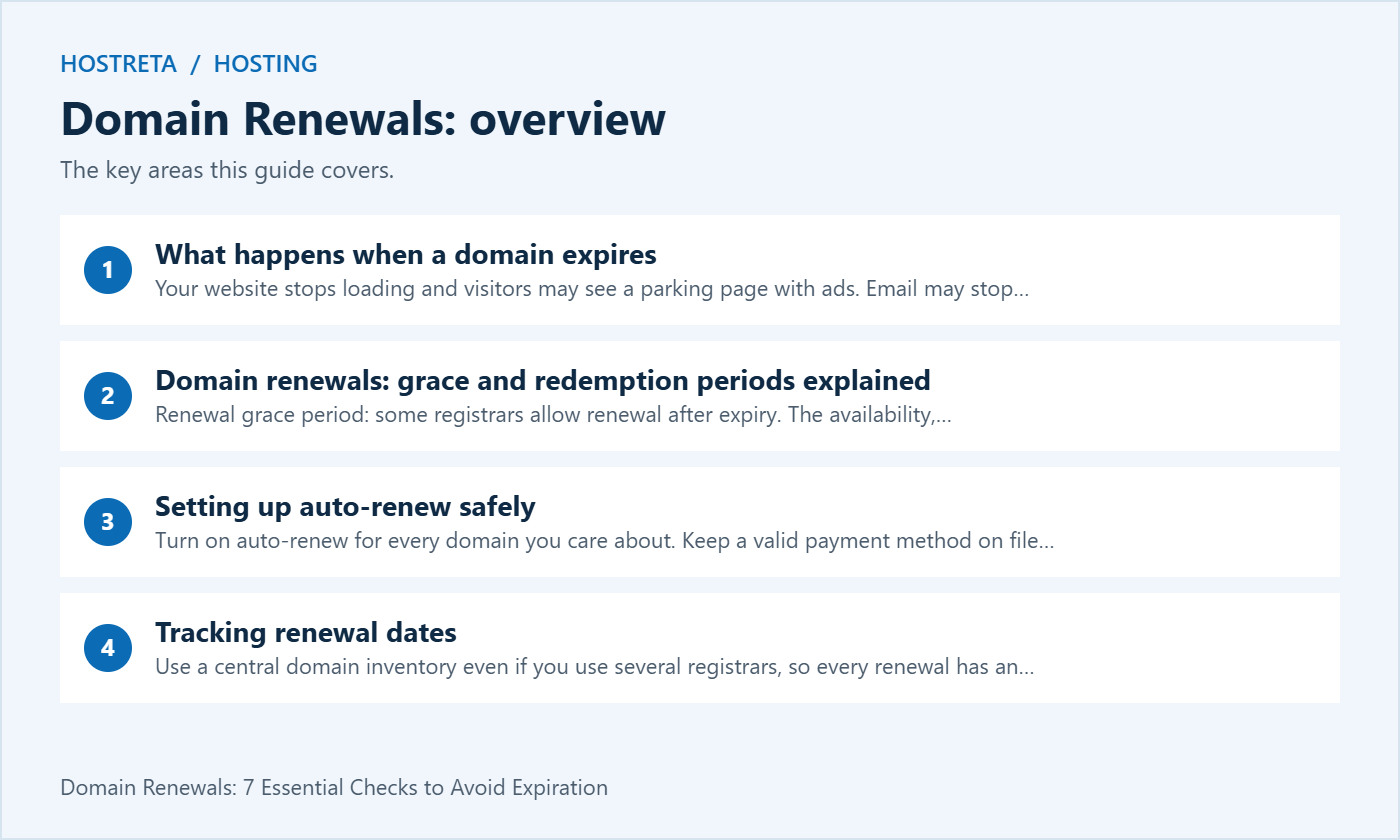
For most generic extensions like .com, the lifecycle looks roughly like this (exact periods vary by registrar and extension):
Country-code domains (like .co.uk or .de) can follow different rules, sometimes with much shorter windows. Check your registrar’s policy for each extension you own.
Also protect the account itself with 2FA and registrar lock — see Domain Hijacking: How to Lock Down Your Domain Name.
Watch renewal prices too. First-year deals are often much cheaper than renewals — if the price jumps, consider moving the domain. See How to Transfer a Domain to Another Registrar.
The right plan makes these checks far easier. For WordPress sites, Kawedma WordPress hosting and managed WordPress hosting powered by Rocket.net include caching, staging, and backups. Growing sites that need guaranteed resources can choose a Kawedma VPS server, cloud hosting, a managed VPS from Hosting.com, or an unmanaged VPS if you prefer full control.
Check the registrar’s published expiration policy for the actual extension. A general lifecycle diagram is useful for understanding the stages, but it is not a personalised recovery deadline. Country-code domains can have different rules, and a registrar may have an auction process or its own post-expiration renewal conditions.
ICANN’s renewal and expiration FAQ explains renewal notices and recovery for covered domains. Its Expired Registration Recovery Policy describes the 30-day Redemption Grace Period following deletion for the generic registries it covers, with stated exceptions. These protections do not make it safe to plan domain renewals after expiry.
| Field | What to record |
|---|---|
| Domain | The full registered name and extension |
| Registrar | The provider holding the registration |
| Owner | The responsible business contact and backup |
| Expiry | The date shown in the registrar account |
| Auto-renew | Enabled status and next payment attempt, if shown |
| Confirmation | Receipt reference and the renewed expiry date |
Keep credentials and payment card details out of this register. For a business, make the inventory accessible to authorised maintainers so a staff change does not hide a critical renewal. Review domains that redirect to your main site as well as the main domain; secondary names may still appear in old campaigns and customer bookmarks.
Contact the current registrar immediately and ask for the exact status, restoration deadline and total fee. If it is in redemption, restoration by the current registrar is normally required before transfer. Do not initiate a last-minute transfer as a substitute for recovery. Once access returns, check the authoritative nameservers, website and mail records against your known configuration.
Allow for cached DNS responses when testing recovery. Check from more than one connection and inspect the actual records before making additional changes. Keep the support case reference and confirm that future domain renewals are enabled with a working notification address.
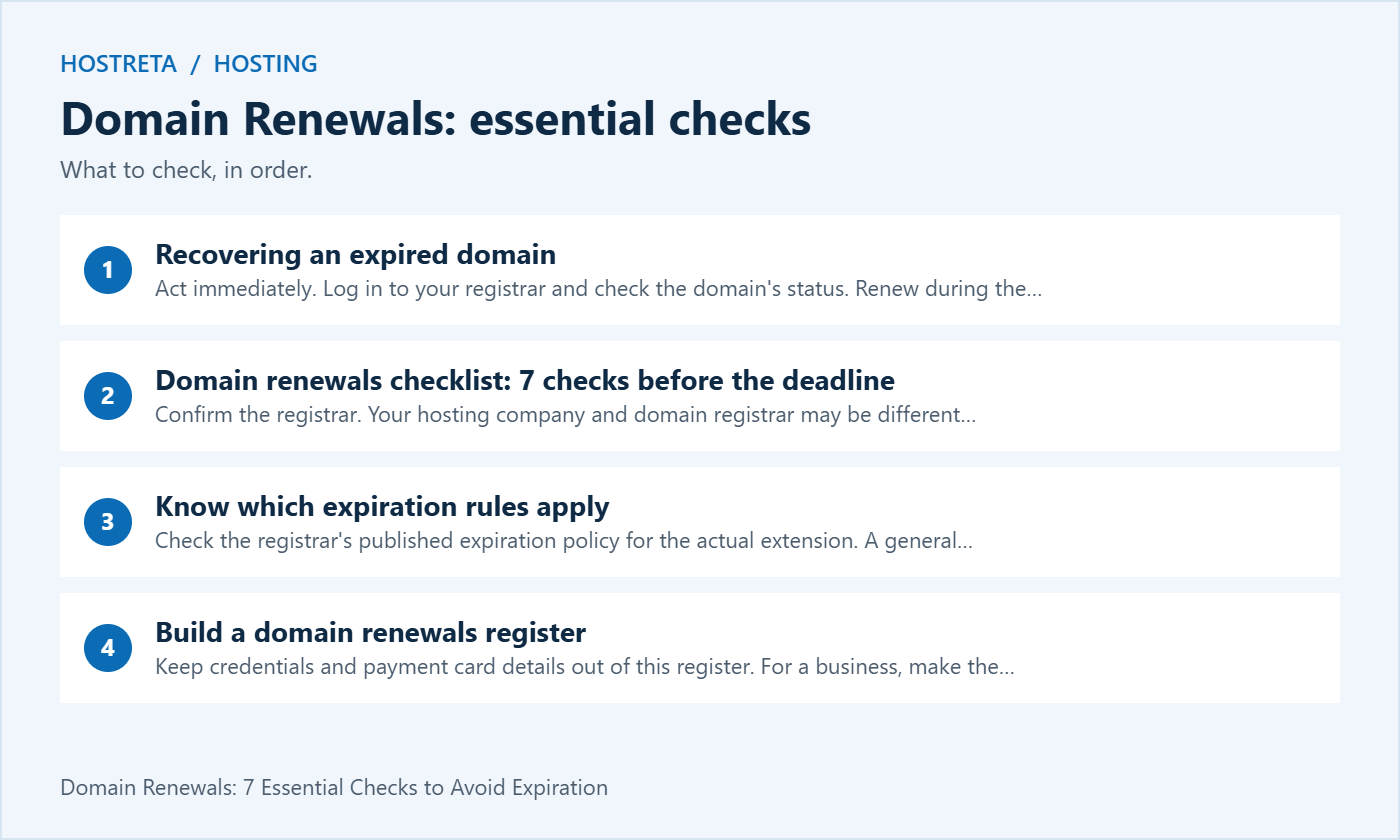
Only if your provider explicitly includes and completes both renewals. Hosting, registration and email are separate services even when sold in one account. Verify the expiry date for each service.
Yes. Payment failures, outdated billing details or account restrictions can prevent completion. Pair auto-renew with independent reminders and verify the updated registration date after payment.
Do not depend on a transfer finishing at the last minute. Check transfer eligibility and timing in advance. If expiry is close, ask your current registrar how to keep the registration active while you plan a move.
List the services that depend on each registration. The main website is obvious, but staff mail, customer login links, invoices and old campaign URLs can also use the name. This dependency list helps the business prioritize checks and understand why a secondary domain still matters.
Do not judge importance only by current traffic. A quiet domain may receive recovery messages for a business account or redirect customers from an older brand. Domain renewals should follow documented business purpose, not an assumption that an unused-looking address can safely expire.
Assign a decision owner for any name the business intends to retire. Review dependencies before that decision and keep the outcome recorded. Renewal administration and a deliberate retirement project are different tasks.
Review the separate roles of registrar, DNS provider and host when assigning renewal responsibilities. If mail is purchased independently, our email hosting vs web hosting guide explains why a working website does not establish the mailbox contract’s status.
A provider may sell registration, hosting and mail together while maintaining separate service dates. Review the actual registration expiry and the renewal status of related services. A paid hosting invoice is not evidence that every item in a bundle was extended.
Keep separate entries in the inventory when terms differ. Record any included renewal benefit and the conditions for keeping it. This makes domain renewals easier to audit when a promotional bundle ends or the website moves to another host.
If a contractor arranged the original package, ask which account owns each service and how the business receives notices. Keep authorized access documented so a change in supplier does not hide a critical deadline.
Check the registration account for the updated expiry date and keep the relevant receipt reference. A card authorization, attempted charge or reminder is not the same as a completed renewal. If the displayed status remains unclear, ask the registrar to confirm the outcome through its official support route.
For domain renewals covering several names, verify each intended item rather than assuming a batch payment included everything. Compare the invoice with the inventory. Record discrepancies early, while the account and transaction details are readily available.
Keep payment credentials out of the general inventory. The operational log needs a confirmation reference and result, not complete card data. Use the organization’s normal financial records and access controls for billing details.
Open the registrar through a known route when a renewal message arrives. Unexpected messages can imitate a supplier or use an unfamiliar payment link. Compare the domain, account and renewal requirement inside the real account before taking action.
Domain renewals can generate several notices, especially when a business uses multiple providers. Establish which inbox receives them and who reviews them. A monitored role address can support continuity if the usual administrator is away, provided account access and recovery remain appropriately controlled.
Keep a clear escalation process for failed payment or imminent expiry alerts. A notice should lead to a recorded check and assigned action, rather than being forwarded through several people with no owner.
Include domain administration in employee and contractor handovers. Confirm the account owner, notification destination and recovery arrangements. The business should not depend on a departed person’s private mailbox to maintain its main registration.
Use the registrar’s supported delegated access where available. Avoid putting shared passwords in a renewal spreadsheet. Domain renewals require continuity of responsibility, but that does not mean every staff member needs unrestricted registrar access.
Review the handover record with the new owner and confirm that independent reminders still reach an active person. Document the next review date and the support route for an account problem.
Compare the actual renewal term, extension, currency and any relevant service conditions. A registration promotion is not a complete picture of ongoing cost. Keep the date and source of the quoted information so a later review can explain why a provider was selected.
If a transfer is being considered, plan it with enough time to verify eligibility and complete the documented process. Domain renewals should not depend on a last-minute transfer finishing before expiry. Ask the current registrar how to maintain the registration while planning the move.
Keep pricing evaluation separate from incident recovery. When a name has already expired, first establish its exact status and available actions. Avoid treating a cheaper advertised first-year price elsewhere as an immediate recovery option.
Imagine a business with a main domain, an older brand redirect and a separate support domain. It records all three registrations, their registrars and their service dependencies. Each entry has a responsible contact and a backup reviewer.
Before the deadline, the owner checks renewal settings and the registrar’s scheduled billing behavior. After the attempt, the owner verifies the updated registration date for every intended domain. One failed item is escalated immediately rather than hidden by the other successful payments.
This domain renewals process does not require a complicated dashboard. It requires a current inventory, independent reminders and verification of the result. A short consistent review is more reliable than assuming the same settings will work forever.
Promotional recommendation: If you are comparing domain services, visit KAWEDMA’s domain services. Ask about the supported extension, current renewal and transfer terms, account ownership and notification process. Confirm the actual conditions for your registration rather than assuming every extension follows one lifecycle.
Include domain renewals in the discussion if the project also involves website or email hosting. Clarify which services are bundled, which have separate dates and who will verify completion. Keep the agreement with your business documentation.
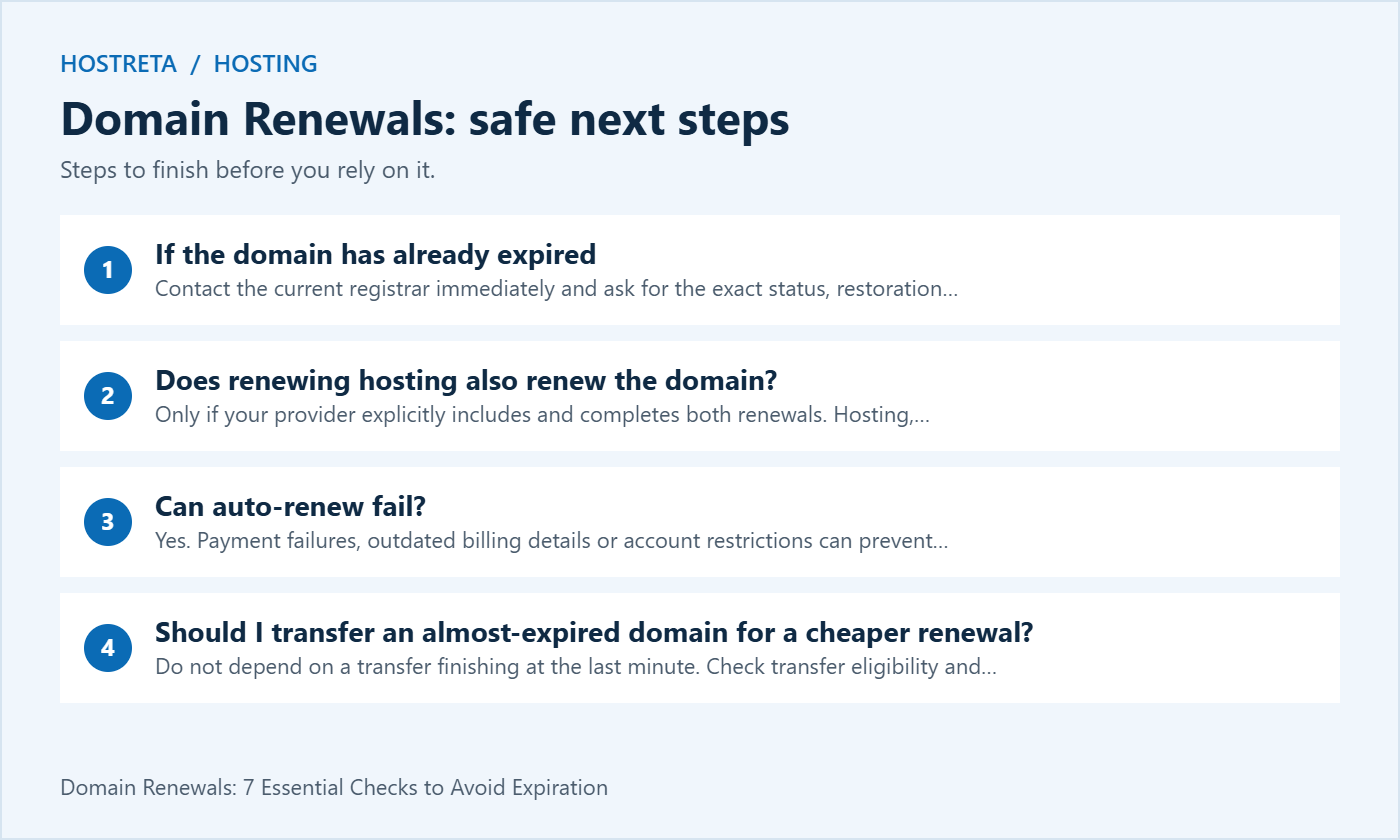
Record the review date, the person who checked the account, the expiry date observed and any action still needed. Add the confirmation reference when a renewal completes. Another authorized maintainer should be able to tell whether an item is pending or finished.
Review the register after a provider change, a rebrand or a staffing change. Remove obsolete assumptions, not merely old rows. Domain renewals become easier to manage when the inventory explains both the current status and the business reason for retaining each name.
Keep unresolved questions assigned to an owner. If the registrar must confirm a status or fee, record the support reference and follow-up date. Do not label the registration safe solely because a reminder was acknowledged.
Before marking the review complete, compare the account status with the inventory one more time. Check the exact spelling and extension of the intended domain, particularly when the business owns similar names. A confirmation for one registration does not cover another name that differs by a suffix or a small spelling change.
Document any domain that still needs investigation and keep it separate from completed items. This makes the next review actionable. A colleague should be able to see which registration was checked, which result was confirmed and which question still belongs with the registrar.
Finally, test the important services if the registration had already been interrupted. A renewed expiry date and a restored website are separate observations. Check mail and any business-critical access route as well. Keep the recovery findings with the domain renewals record so the team can distinguish an administrative completion from a technical issue that still needs attention.
Review the reminders after recovery and confirm that a current authorized person will receive the next notice.
Use the registrar’s current extension-specific policy when confirming any remaining recovery deadline.
We may earn a commission on purchases made through these links, at no extra cost to you.
Don’t miss the chance to participate in the biggest giveaway of this year.